
Industrial Wheels for Carts, Dollies and Equipment
Replacement and new wheels matched to the load, the floor and the environment: polyurethane, rubber, cast iron, forged steel, nylon and phenolic, with the right bearing. From Colson, Darcor and Hamilton Caster, and Frantz for conveyor skate wheels.
Every material
From soft rubber to forged steel.
Matched bearings
Plain, roller, ball, precision and sealed.
Replacements
Send a photo and measurements and we will match it.
Complete casters
Need the fork too? See casters.
Tread and core
The tread is the outer rolling surface: it sets traction, noise and floor protection. The core is the structure inside: it sets load capacity and durability. A soft or reinforced tread on a strong core can roll quietly on a finished floor without giving up load rating, which is why we help you choose the two together.
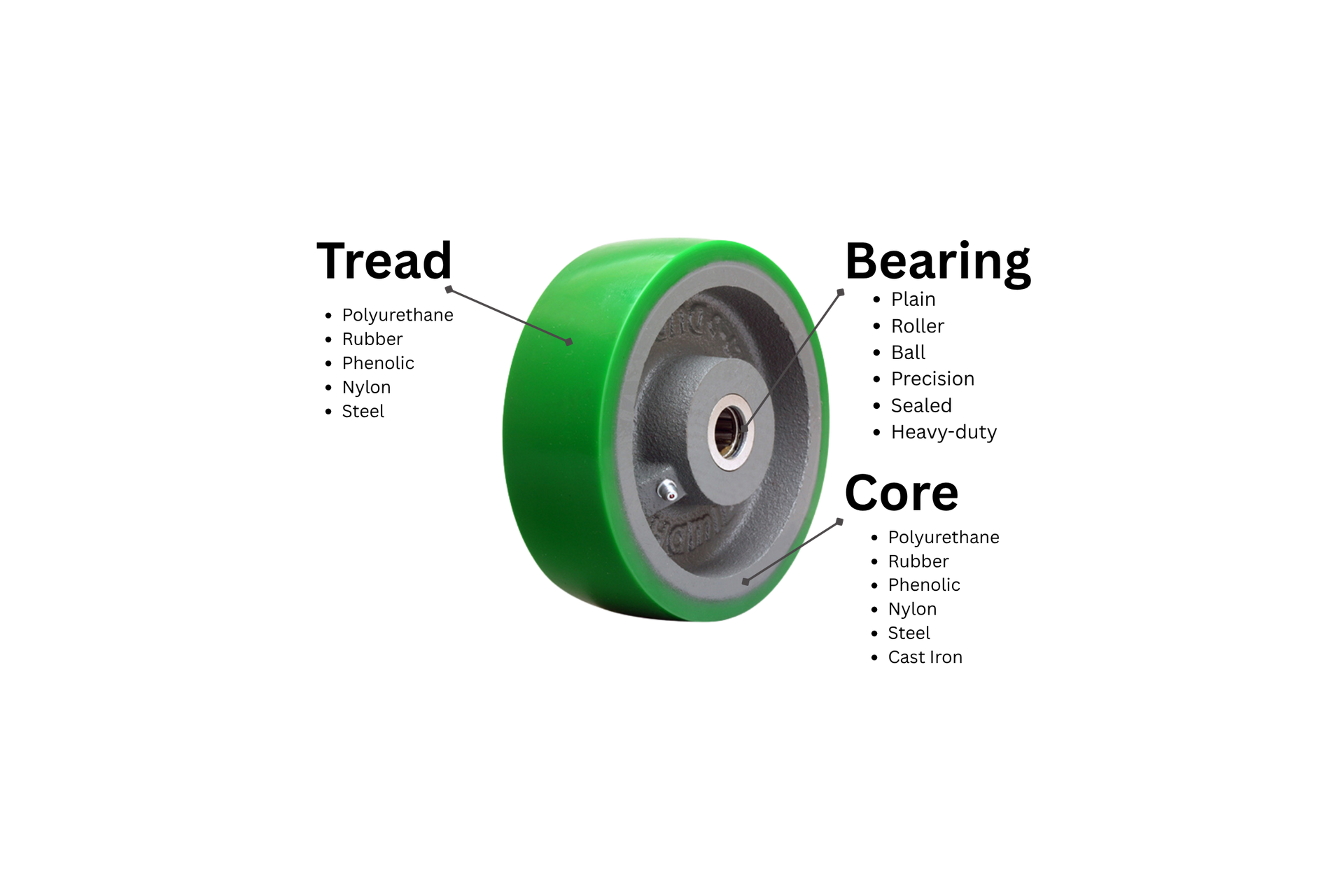
Wheel materials compared
Every material trades load capacity against floor protection, noise and durability.
| Material | Strengths | Watch for | Typical use |
|---|---|---|---|
| Polyurethane | High capacity, floor-friendly, quiet | Heat and some chemicals | Most indoor material handling |
| Rubber | Quiet, absorbs shock | Lower capacity; choose non-marking for finished floors | Carts in noise-sensitive areas, delicate loads |
| Cast iron / forged steel | Highest loads, rough floors, durability | Noise, shock, marks soft floors | Heavy industrial equipment, rough plant floors |
| Nylon | Tough, chemical resistant, rolls easily | Noisy and hard on floors | Washdown and chemical areas, heavy carts |
| Phenolic | Heat and chemical resistance, high capacity | Hard ride; can chip under heavy impact | Ovens, bakeries, heat-treat areas |
Wheel bearings
The bearing sets how easily the wheel rolls, how much it carries and how long it lasts.
Plain and roller
Economical, for lighter duty and slower speeds.
Ball
Smoother and easier rolling, for higher speeds and frequent moves.
Precision and sealed
Longer life and less maintenance; keeps dirt and washdown water out.
Heavy duty
For high loads where standard bearings wear early.
Replacing a wheel: what to send us
Diameter and width
The wheel diameter and the tread width.
Hub length
The width across the hub, so it fits between the legs of the fork.
Axle or bore
The axle diameter, or the bearing bore.
Load
The weight the wheel carries.
Floor and environment
Floor type, wet or chemical exposure, heat.
A photo
Of the old wheel, and any markings on it.
Wheel brands we source
Jealco has worked with Frantz Manufacturing for more than 30 years, and Frantz is our main source for conveyor and industrial skate wheels. For cart, dolly and machinery wheels we also source Colson, Darcor and Hamilton Caster, and as an independent distributor we can match other brands and sizes.
Casters
Complete caster assemblies in every duty class.
Bearings and skate wheels
Frantz conveyor skate wheels and bearings.
Frantz
More about Frantz Manufacturing products.
Wheel FAQ
What is the difference between a wheel and a caster?
A wheel is the round, load-carrying part. A caster is a wheel mounted in a fork or rig that bolts or plugs into equipment, and on a swivel caster lets it turn. We supply both; see our casters page for complete assemblies.
Which wheel material should I choose?
Polyurethane is the usual choice indoors: high capacity and kind to floors. Rubber is quiet and absorbs shock. Cast iron and forged steel carry the heaviest loads on rough floors but are noisy and can mark soft floors. Nylon and phenolic resist heat and chemicals. Match the material to the floor, the load and the environment.
What are tread and core, and why do they matter?
The tread is the outer surface that touches the floor; it sets traction, noise and floor protection. The core is the structure inside; it sets load capacity and durability. A soft tread on a strong core can roll quietly without giving up load rating, so choose them together.
Which bearing should I choose?
Plain and roller bearings are economical for lighter, slower duty. Ball bearings roll more easily and suit higher speeds and frequent moves. Precision and sealed bearings last longer and keep dirt and washdown water out. Heavy-duty bearings suit high loads.
What do I need to replace a wheel?
The wheel diameter and tread width, the hub length (the width across the hub, so it fits between the legs of the fork), the axle or bore diameter, and the load. A photo and those measurements are usually enough for us to match it.
Do you supply conveyor skate wheels?
Yes. Frantz Manufacturing is our main source for conveyor and industrial skate wheels; see our bearings and skate wheels page.
Can you source wheels not listed here?
Yes. As an independent distributor we can source other materials, sizes and load ratings. Send your application details and we will find the right fit.
Tell us the load, the floor and the size
Send the measurements and a photo of the wheel you are replacing, or the load and floor for a new application. We will match the wheel and bearing.