In this technical guide, we cover:
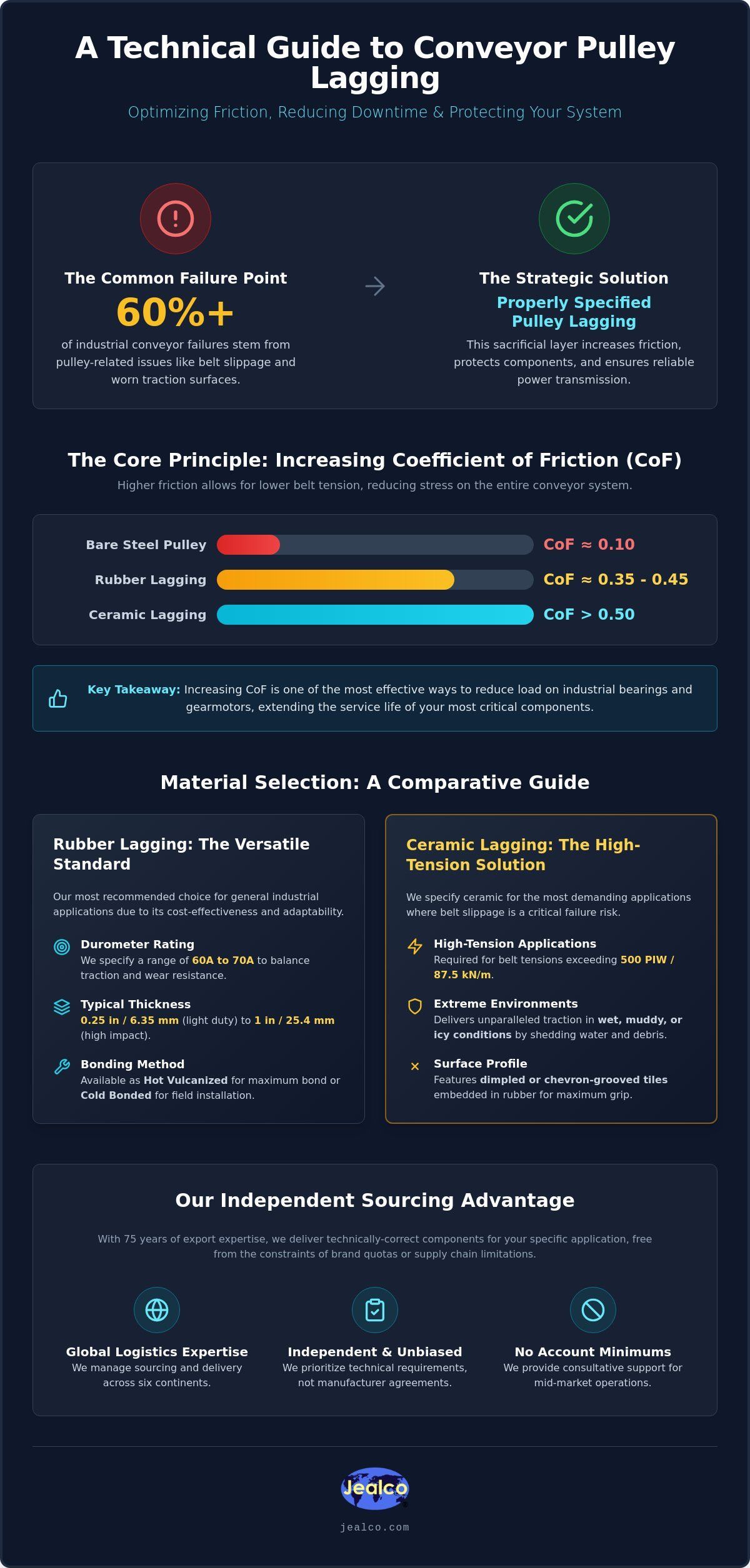
- Friction Optimization: Learn how increasing the Coefficient of Friction (CoF) acts as the primary defense against belt slippage and premature motor failure.
- Rubber Specifications: Identify the correct compounds for standard use, focusing on durometer ratings between 60A and 70A and thicknesses from 0.25 in / 6.35 mm to 1 in / 25.4 mm.
- High-Tension Solutions: Understand when to transition to ceramic lagging for applications exceeding 500 PIW / 87.5 kN/m to ensure reliable traction in extreme or wet environments.
- Downtime Mitigation: Explore modular and replaceable lagging systems that allow your maintenance teams to restore performance without the delays of full pulley removal.
- Strategic Procurement: Use our export experience since 1950 to source the components identified in this conveyor pulley lagging material guide across six continents, prioritizing technical specs over brand quotas.
The Engineering Fundamentals of Conveyor Pulley Lagging
We define pulley lagging as the specialized elastomer or ceramic coating bonded to the outer shell of a conveyor pulley. This conveyor pulley lagging material guide focuses on how this layer serves as the critical interface between the drive system and the belt. Our primary objective when selecting lagging is to increase the Coefficient of Friction (CoF). Higher friction ensures that the drive pulley transmits power efficiently without the belt slipping during startup or high-load periods.
Properly specified lagging also improves belt tracking and mitigates the accumulation of material, commonly known as carryback. When material builds up on a bare steel pulley, it creates an uneven surface that forces the belt off center. Profiled lagging patterns shed water and debris effectively. This maintains a consistent contact surface and prevents the abrasive grinding effect that destroys both the pulley and the belt carcass.
Coefficient of Friction and System Tension
To understand the Engineering Fundamentals of Conveyor Pulley Lagging, engineers look at the Euler-Eytelwein formula. In plain language, this principle states that the amount of torque a pulley can transmit depends on the friction between the surfaces and the wrap angle. A bare steel pulley offers a low CoF of approximately 0.10. By contrast, rubber lagging increases this to 0.35 or 0.45; ceramic lagging can exceed 0.50.
Increasing the friction allows you to operate with lower take-up tension. Lower tension reduces the radial load on your industrial bearings and extends the life of your gearmotors. Reducing unnecessary tension is one of the most effective ways to prevent premature shaft failure. Our independent sourcing model allows us to recommend the specific CoF required for your load without being tied to a single manufacturer's inventory.
Protecting the Pulley Shell and Belt Carcass
We view lagging as a sacrificial wear surface. It's much more cost effective to replace a layer of rubber than to replace an entire welded steel pulley shell that has thinned due to abrasion. Lagging provides a resilient cushion that absorbs the impact of heavy loads. This protection is vital for heavy-duty conveyor belting, where the bottom cover is susceptible to gouging from trapped particles.
High-speed operations generate significant heat at the pulley interface. Quality lagging materials assist in heat dissipation, preventing the belt's rubber compounds from hardening or cracking. Systems using optimized lagging see a marked decrease in belt cover wear. This technical approach ensures that your conveyor components reach their full engineered service life even in 24/7 production environments.
Rubber Lagging: Selecting Compounds and Surface Profiles
Rubber remains the most prevalent choice for industrial pulleys due to its cost effectiveness and adaptability. Selecting the correct durometer is the first step in any conveyor pulley lagging material guide. We typically recommend a rating between 60A and 70A. This range provides the necessary balance between flexibility for traction and hardness for wear resistance.
Thickness typically ranges from 0.25 in / 6.35 mm for light duty systems to 1 in / 25.4 mm for high impact zones. You must choose between hot vulcanized and cold bonded applications based on your maintenance capabilities. Hot vulcanization offers the strongest bond but requires factory processing. Cold bonding allows for field installation using high quality belting accessories and specialized metal to rubber adhesives.
When performing field re-lagging, your teams must strictly adhere to OSHA conveyor safety regulations regarding lockout/tagout and pulley guarding. We provide the technical documentation needed to ensure these installations meet international safety and performance standards. If you are unsure which compound fits your specific chemical environment, consult with our technical specialists for a site specific recommendation.
Elastomer Compounds: SBR, Neoprene, and Nitrile
- SBR (Styrene-Butadiene Rubber): This is the versatile standard for non-oil applications. It offers excellent abrasion resistance for general industrial use.
- Nitrile (Buna-N): We specify Nitrile for oil resistant requirements in grain or chemical handling. It prevents the lagging from swelling or softening when exposed to hydrocarbons.
- Neoprene: This compound provides superior weather, ozone, and flame resistance. It's the preferred choice for outdoor installations or underground mining where fire safety is paramount.
Groove Patterns: Diamond, Herringbone, and Chevron
Plain or smooth lagging is best for non-drive pulleys to minimize belt wear. For drive pulleys, we utilize Diamond (Grooved) patterns as the all-purpose choice for shedding water and dirt. The grooves provide a path for moisture to escape, maintaining the Coefficient of Friction in damp environments.
Herringbone and Chevron patterns are directional designs engineered for maximum water expulsion in wet climates. You must install these with the "apex" pointing in the direction of belt travel to function correctly. Our independent status allows us to source these specific profiles from global manufacturers without the lead time constraints of brand specific agreements.
Ceramic Lagging: Solving High-Tension and Wet-Condition Challenges
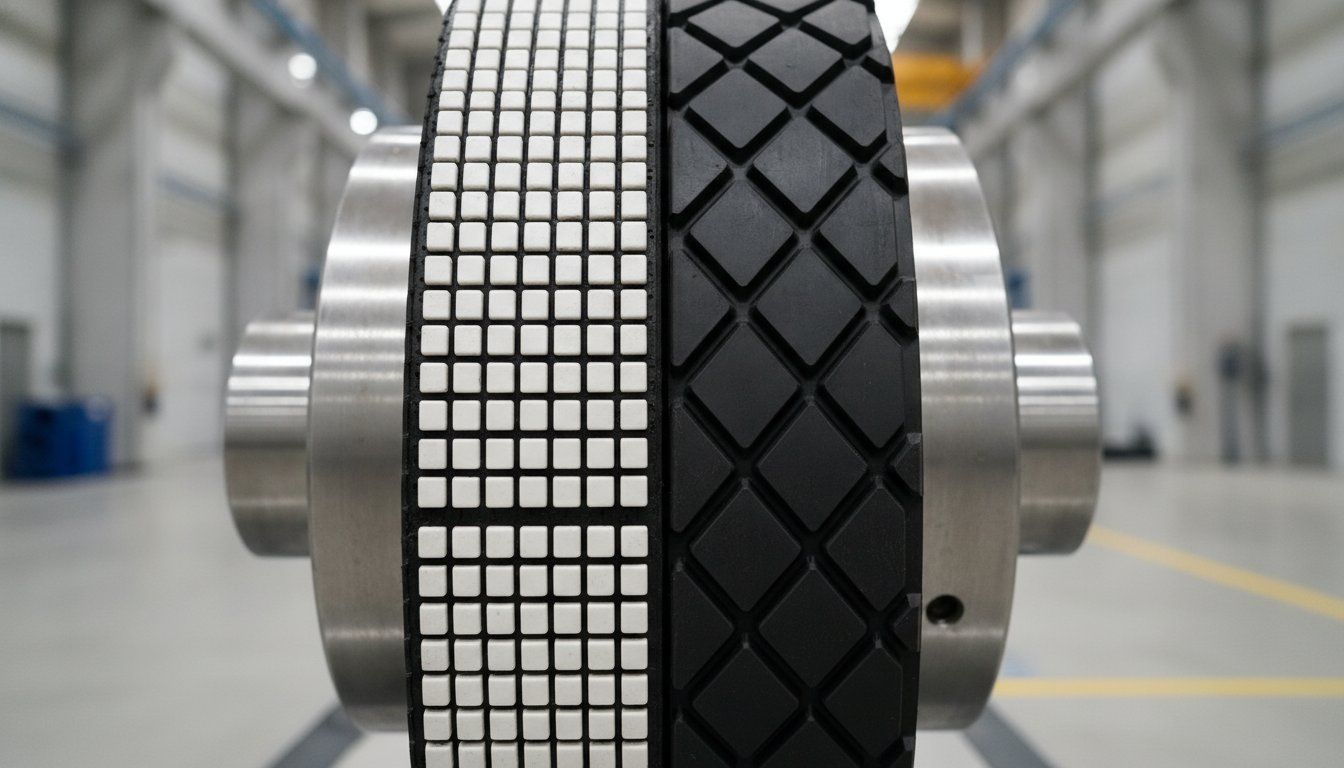
We define ceramic lagging as a composite material consisting of high-grade Alumina (Al2O3) tiles vulcanized into a resilient rubber backing. It is the stronger choice for high-tension systems where loads exceed 500 PIW / 87.5 kN/m. Standard rubber lagging often fails under these extreme radial pressures because the elastomer compresses and loses its grip. Ceramic tiles maintain their structural integrity, providing a stable contact surface that ensures efficient power transmission regardless of the load profile.
A common misconception in the industry is that ceramic lagging is "belt-aggressive" and causes premature wear to the belt carcass. This conveyor pulley lagging material guide clarifies that correctly specified ceramic actually extends belt life. By eliminating slippage, you prevent the friction-induced heat that typically hardens and cracks the bottom cover of your heavy-duty conveyor belting. We ensure maximum shear strength by utilizing tiles with a specialized bonding layer, creating a chemical connection between the rubber substrate and the pulley shell that is often stronger than the rubber itself.
Dimpled vs. Smooth Ceramic Tiles
Dimpled ceramic tiles feature hundreds of small, molded protrusions that "bite" into the belt cover. This mechanical interlock provides nearly 100% traction even in heavily lubricated or wet conditions. Smooth ceramic tiles are used for non-drive pulleys, such as tail or snub pulleys, to provide extreme wear resistance without the high friction that causes belt drag. We typically specify an 80% ceramic coverage pattern for high-torque drive pulleys, while a 39% coverage pattern is sufficient for standard applications where cost-efficiency is a priority.
Extreme Environment Applications
Ceramic lagging excels in environments involving slurry, mud, or ice where traditional rubber lagging fails to maintain a consistent Coefficient of Friction. The hard ceramic dimples penetrate the surface film of contaminants to reach the belt cover directly. Alumina ceramic tiles possess a hardness of 9 on the Mohs scale, which is second only to diamond. In aggressive mining environments, our technical data shows that ceramic lagging life expectancy is often three times longer than that of traditional rubber alternatives. Our independent sourcing model allows us to supply these high-performance materials globally without the lead time constraints of brand-specific agreements.
Modular and Replaceable Lagging for Reduced Downtime
For facilities operating on 24/7 production schedules, the traditional process of removing a pulley for re-lagging is often cost-prohibitive. We recommend Slide-Lag and Weld-On systems as the primary solution for these high-availability environments. This conveyor pulley lagging material guide highlights these modular options because they allow your maintenance teams to replace wear surfaces without removing the pulley from the conveyor frame. By performing the replacement in-situ, you eliminate the need for heavy lifting equipment and significantly reduce the labor hours required for system restoration.
The mechanics of these systems rely on rubber-to-metal vulcanized strips that slide into metal retainers welded directly to the pulley shell. This design creates a secure, mechanical bond that handles high-torque applications as effectively as traditional cold bonding. We evaluate the Total Cost of Ownership (TCO) by looking beyond the initial material price. While modular systems require a higher upfront investment for the retainer tracks, the long-term savings in reduced downtime and simplified logistics across your global operations provide a much higher return on investment.
Our status as an independent distributor means we source these modular components based on your specific engineering requirements rather than manufacturer quotas. We use our export experience since 1950 to ensure these heavy steel-backed components reach your site across six continents without the delays common in restricted supply chains. If you need to upgrade your existing pulleys to a replaceable system, contact our technical team for a modular lagging specification quote.
Slide-Lag and Weld-On Systems
A technical breakdown reveals that the foundation of a modular system is the retainer track. These tracks are welded to the pulley rim at specific intervals to match the pulley's circumference. Installation involves measuring the shell, welding the retainers, and then cutting the lagging strips to the correct face width. During routine maintenance, your technicians should inspect the retainers for wear and ensure no strip migration has occurred. If a single strip is damaged by tramp metal, you only replace that specific segment rather than the entire pulley surface.
Strip Lagging for Rapid Repair
Strip lagging typically utilizes 5.5 in / 140 mm wide strips, which are much easier for a single technician to handle compared to large, heavy rubber sheets. This modularity allows for targeted repairs in high-wear areas, such as the center of the pulley face, without wasting material on the edges. You can find detailed technical specifications and standard strip dimensions in our online catalog. This approach to maintenance aligns with our consultative focus on resource optimization, ensuring you only pay for the materials your system actually consumes.
Strategic Sourcing: Navigating Global Logistics for Pulley Lagging
Sourcing heavy industrial components across six continents presents significant logistical hurdles that many large-scale distributors often ignore. This conveyor pulley lagging material guide emphasizes that the most advanced technical solution is useless if it's stuck in customs or held up by brand-specific supply chain constraints. We operate as a truly independent distributor. This means we source materials based on your engineering specifications rather than meeting manufacturer-imposed sales quotas. Our independence allows us to prioritize the functional performance of your system over a specific brand's current inventory levels.
We manage the entire export process for you. This includes the complex documentation required for oversized pulleys and high-density lagging materials that can weigh several thousand pounds. This flexibility allows us to support mid-market clients with the same level of technical precision we provide for large-scale infrastructure projects. We've built our reputation on being a reliable global sourcing partner that removes the friction from international procurement.
Export Logistics and International Compliance
Our team brings export experience since 1950 to the table when navigating global supply chain constraints. We handle the technical classification of HS codes and customs valuation for specialized industrial elastomers. This prevents the costly delays that occur when paperwork doesn't match the technical nature of the goods. We ensure that every component meets the specific regional standards of your operation. This includes MSHA requirements for North American mining or DIN standards for European industrial applications. Our logistics expertise ensures that your lagging arrives ready for immediate installation.
The Consultative Mid-Market Approach
We focus on engineering the right solution for your specific load and environmental conditions rather than pushing high-volume generic sales. Our technical support team assists in the material selection process without the limitations of on-site labor contracts or brand agreements. We often integrate our pulley lagging recommendations with our extensive inventory of electric motors and gearboxes. This creates a complete, high-efficiency drive solution for your facility. By looking at the system as a whole, we help you reduce energy consumption and extend the life of every component in your conveyor string.
Optimizing Your Conveyor Performance and Reliability
Selecting the right lagging material is essential for reducing system tension and extending the life of your belts and motors. We've shown that whether you choose high-friction ceramic for wet conditions or modular systems for 24/7 uptime, technical specifications must drive your procurement strategy. This conveyor pulley lagging material guide serves as a foundation for making data-driven decisions that reduce the Total Cost of Ownership across your entire conveyor network.
We use our export experience since 1950 to ensure you receive the exact components your engineering team requires. As an independent distributor, we offer solutions free from brand-specific constraints and manage complex global logistics across six continents. Contact Jealco International, Inc. for an independent technical consultation on your pulley lagging requirements. We're ready to help you achieve a more reliable and efficient operation.
Frequently Asked Questions
How do I know when my pulley lagging needs to be replaced?
You should replace lagging when you notice visible thinning of the material or if the belt begins to slip despite proper tensioning. Once the groove depth on rubber lagging is reduced to 1/8 inch / 3.17 mm, the ability to shed water and debris is compromised. Inspect the pulley face for exposed metal or "bald" spots which indicate that the sacrificial wear surface is no longer protecting the shell.
Can I install ceramic lagging on a pulley that currently has rubber?
We can definitely install ceramic lagging on a pulley that previously used rubber, provided the shell is thoroughly cleaned and prepared. The old rubber must be completely stripped away and the metal surface sandblasted to a near-white finish to ensure a proper bond. This transition is a key recommendation in our conveyor pulley lagging material guide for drive pulleys facing high-tension requirements or persistent slippage.
What is the best lagging for wet and slippery conveyor environments?
Dimpled ceramic lagging is the most effective solution for wet and slippery environments because the protrusions penetrate moisture films to maintain traction. If your budget favors rubber, we recommend a herringbone or chevron groove pattern. These directional designs act like tire treads to expel water away from the contact area, though they require specific orientation relative to the direction of belt travel.
Does pulley lagging affect the warranty of my conveyor belt?
Using the correct lagging generally protects your conveyor belt warranty by preventing the heat and abrasion caused by slippage. Most belt manufacturers require a specific Coefficient of Friction at the drive pulley to ensure the belt operates within its engineered parameters. Inadequate lagging can be grounds for a denied warranty claim when premature bottom cover wear occurs.
How much does pulley lagging improve the life of a conveyor system?
Proper lagging extends the life of your conveyor components in high-abrasion environments. By eliminating slippage, you reduce the heat load on the belt and the radial load on your industrial bearings and motors. This conveyor pulley lagging material guide emphasizes that lagging is a sacrificial layer; replacing it is far cheaper than replacing a thinned pulley shell or a damaged belt carcass.
Is it better to use hot vulcanized or cold bonded lagging?
Hot vulcanized lagging offers the strongest chemical bond and is preferred for new pulleys or factory rebuilds. Cold bonding is the superior choice for field repairs where removing the pulley is not feasible. We provide high-performance cold bonding adhesives and technical support to ensure these field applications achieve maximum shear strength without the need for an autoclave.
Can I replace pulley lagging without removing the pulley from the conveyor?
You can replace lagging without removing the pulley if you utilize modular Slide-Lag or Weld-On strip systems. These designs use metal retainers welded to the shell that allow technicians to slide out worn segments and slide in new ones. This method is ideal for 24/7 operations where downtime must be kept to a minimum; it eliminates the need for heavy rigging and pulley extraction.
What are the most common causes of lagging failure?
The most common causes of lagging failure include improper surface preparation during cold bonding and excessive belt tension that exceeds the material's shear strength. Failures are also frequently caused by tramp metal or material build-up between the belt and pulley which gouges the lagging. Selecting a compound that is incompatible with transported oils or chemicals will also cause rapid swelling and debonding.