
Light Duty Conveyor Belting
Thin, flexible fabric-ply belting for packaging, food processing, parcel handling, slider beds and power transmission. Rated 35 to 280 PIW, and cut to your width and length.
This page explains the six light duty families and how to choose between them. Every belt, with its full specs, is in our online store.
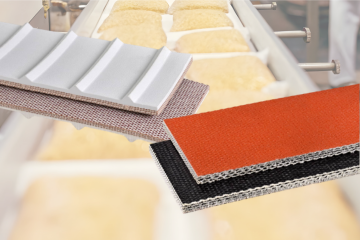
Six families
Food, general purpose, hot stock and water, package handling, solid woven cotton and transmission.
35 to 280 PIW
From a 2-ply 35 PIW food belt to an 8-ply 280 PIW transmission belt, 2 to 9 plies.
FDA food contact
White, green and tan nitrile, white RMV rubber, butyl, PTFE (Teflon) and solid woven cotton.
Cut and finished
Cut to your size, with lacing, endless splicing, cleats, sidewalls and V-guides quoted to order.
Start here: which light duty belt do you need?
Most people arrive knowing the job, not the construction. Find your situation and follow the link to the matching belts.
| If your situation is… | Look at | Why |
|---|---|---|
| The belt touches food | Food belting | FDA-approved white, green and tan covers, 35 to 150 PIW |
| Product is hot, wet or sticky | Hot stock and water | Silicone covers rated to 500 °F, or a bare cotton duck top |
| You are moving cartons, totes or parcels | Package handling | Covered tops for grip, several with bare backs that slide easily on a slider bed |
| General conveying, nothing special about the product | General purpose | Nitrile-covered and friction-surface belts, 36 to 225 PIW |
| The belt drives something rather than carries it | Transmission | Friction surface on both sides, 90 to 280 PIW |
| You want the lightest, most flexible belt | Solid woven cotton | No rubber cover at all: a single woven cotton carcass, 45 to 110 PIW |
| Product sticks to the belt | Silicone covers or the PTFE (Teflon) food belt | Silicone releases hot, tacky product; PTFE gives a hard, slick, non-stick surface |
| Product slides back on an incline | Incline belting | Roughtop, wedgegrip and ribbed tops that grip cartons and bags |
| You need a PVC belt | PVC belting | A different construction, with its own page |
| Material is sharp, abrasive or dropped from a height | Heavy duty belting | Light duty belts are not built for impact or bulk-material abrasion |
What light duty belting is, and where it stops
Light duty versus heavy duty
Light duty belting is fabric-ply belting built to carry product : thin covers or none at all, a flexible carcass that bends around small pulleys, and tension ratings from 35 to 280 PIW. It suits steady loads such as boxes, bags, produce, packaged food and finished parts.
Heavy duty belting is built to survive material : thicker rubber covers to absorb impact and abrasion, and ratings from 150 to 600 PIW. The line between them is rarely about the weight of the product. It is about impact, abrasion and tension. If lumps drop onto the belt, or the material is sharp, you want heavy duty belting.
Light duty versus PVC
The belts on this page are fabric-ply constructions: layers of woven fabric bonded with rubber, usually with a rubber cover or friction surface on each face. That is what a name like "3-ply nitrile COS" describes. PVC belting is a PVC cover on an interwoven polyester carcass, and has its own page: PVC conveyor belting.
How PIW works on a light duty belt
PIW is pounds per inch of width: the working tension one inch of belt width is rated to carry. A 3-ply 90 PIW belt run 24" wide is rated for about 2,160 lb of working tension across the belt, not 90.
On light duty belting, PIW depends on the fabric as well as the number of plies, which is why a 2-ply and a 3-ply belt can carry similar ratings. When you replace a belt, match PIW and thickness first and ply count second. See What is PIW? for more, and the conveyor belt calculator to work out belt length.
How to read a light duty belt name
Belt names are written in shorthand. These two tables decode it.
The abbreviations
| Term | Stands for | What it means in practice |
|---|---|---|
PIW
|
Pounds per inch of width | The belt's rated working tension per inch of width |
PLY
|
Fabric layer | Layers of woven fabric in the carcass; more plies generally means more strength and less flexibility |
COS
|
Cover One Side | Rubber cover on top, a thin friction surface underneath |
FS
|
Friction Surface | No thick cover; a thin rubber skim is the running surface |
FBS
|
Friction Both Sides | Friction surface on both faces, no cover on either |
BARE
|
Bare fabric face | Exposed fabric; slides more easily on a slider bed |
MOR
|
Moderate Oil Resistant | A cover with moderate oil resistance |
SBR
|
Styrene-butadiene rubber | General-purpose rubber with good abrasion resistance, not oil resistant |
POLY
/ CP30
|
Carcass fabric | Polyester fabric / cotton-polyester blend fabric |
15 OZ.
/ 35 OZ.
|
Fabric weight | Weight of the carcass fabric; heavier fabric, higher rating per ply |
RMV
|
Cover compound | A white food-grade rubber cover, an alternative to white nitrile |
PEBBLETOP
|
Textured cover | Lightly textured top for a little extra grip |
MEATCLEAT
|
Ribbed cover | Ribbed food-grade top for carrying product up an incline |
SLIPTOP
|
Low-friction top | Hard-woven nylon top so product can slide or accumulate |
DUCK
|
Cotton duck | Heavy, tightly woven cotton fabric, used as a carcass or as an exposed top |
Cover compounds at a glance
| Compound | Strengths | Where it appears |
|---|---|---|
| Nitrile | Resists oil, grease and animal fats | Most food belts, and general purpose covered belts |
| White RMV rubber | White food-grade cover | Two food belts, 100 and 150 PIW |
| Butyl | Wide temperature range, -65 °F to 300 °F | One 105 PIW food belt |
| PTFE (Teflon) | Hard, slick, non-stick surface | One 105 PIW food belt |
| Silicone | Non-stick and heat resistant, rated to 500 °F | Hot stock and water belts |
| SBR | Good abrasion resistance, low cost | Transmission and package handling belts |
| MOR | Moderate oil resistance | The heavier package handling belts |
| Neoprene | Static-conductive friction surface | The 180 PIW general purpose belt |
| Solid woven cotton | Light, flexible, no rubber at all | The solid woven cotton family |
Every belt's page in the store has its own "What the name means" table.
The six light duty families
Each button opens that family in the store, with every belt's specs, width options and a quote button.
Food
- Rated tension 35 to 150 PIW
- Plies 2 to 5
- Covers Nitrile, RMV, butyl, PTFE
- Tops Smooth, pebbletop, meatcleat
White, green and tan covers for bakery, produce, packaged food, meat and poultry lines.
Shop Food BeltingGeneral Purpose
- Rated tension 36 to 225 PIW
- Plies 2 to 9
- Builds Nitrile covered, friction both sides, sliptop
Covered nitrile belts for assembly and packaging lines, friction-both-sides belts, a checkout-counter belt and a low-friction sliptop for accumulation.
Shop General PurposeHot Stock and Water
- Rated tension 90 to 120 PIW
- Plies 3 to 4
- Tops Silicone (to 500 °F), bare cotton duck
For uncured rubber, tire plants and wet, tacky or warm product.
Shop Hot Stock and WaterPackage Handling
- Rated tension 90 to 220 PIW
- Plies 2 to 4
- Covers SBR, MOR, nitrile, bare
Smooth and pebbletop covers, several with bare backs that slide easily on a slider bed.
Shop Package HandlingSolid Woven Cotton
- Rated tension 45 to 110 PIW
- Plies 2 to 4
- Food contact FDA approved
Cotton woven into a single carcass: light and flexible, for food and baking lines and slider beds.
Shop Solid Woven CottonTransmission
- Rated tension 90 to 280 PIW
- Plies 3 to 8
- Carcass CP30, or 35 oz. silver hard duck
SBR friction surfaces on both faces, for power transmission, slider and roller beds, and bucket elevators.
Shop TransmissionLight duty incline belts (roughtop, wedgegrip and ribbed tops) are grouped with all our other incline belts: shop incline belting or read the incline guide.
Cut, joined and shipped to your size
Every belt is cut to order, and we can finish it before it ships. Finishing is quoted to order, because sizes and options vary. Tell us your application requirements and we will recommend the right setup.
- Cut to size Your width and your length.
- Mechanical lacing Installed. Each belt's store page lists the lacing that suits it.
- Endless splicing Vulcanized or glued, for a seamless loop.
- Cleats and sidewalls Added to your dimensions.
- V-guides Bonded to the underside to help the belt track.
Lacing it yourself? Fasteners, splice kits and adhesives are on our belting accessories page.
Light duty belting FAQ
What does "light duty" mean, and when do I need heavy duty?
Light duty belting is fabric-ply belting rated about 35 to 280 PIW, with thin covers or none at all, built to carry product rather than survive impact.
Move up to heavy duty when material drops onto the belt from a height, when it is sharp or abrasive (aggregate, scrap, ore), when you need thick covers to absorb wear, or when the drive needs more tension than a light duty belt is rated for. For boxes, bags, produce, packaged food or finished parts, light duty is almost always the right family.
Is light duty belting the same as lightweight belting?
In everyday use, yes. Most people searching for lightweight belting or a light conveyor belt mean thin, flexible belting for carrying product rather than bulk material. Some suppliers use "lightweight" for plastic (thermoplastic) belts. If you are not sure what you are replacing, send us the old belt's name or a photo and we will identify it.
Do you sell PVC belting?
Yes, on its own page: PVC conveyor belting. PVC belts have a PVC cover on an interwoven polyester carcass, rather than rubber on fabric plies.
What makes a belt FDA approved, and when do I need one?
An FDA-approved belt has a cover made from compounds approved for contact with food. Our food belts use white, green or tan nitrile, white RMV rubber, butyl or PTFE (Teflon), from 35 to 150 PIW, and our solid woven cotton belts are FDA approved too.
You need one wherever the belt touches food, or where an inspector or customer audit requires food-contact materials. If your line is also USDA-inspected, confirm the belt meets the rules for your product.
What do COS, FS, FBS and "bare" mean?
They describe each face of the belt. COS is Cover One Side: rubber on top, a thin friction surface underneath. FS is a friction surface: a thin rubber skim instead of a thick cover. FBS is friction on both sides. Bare means the fabric is exposed on that face, which slides more easily on a slider bed. So "1/16 X FS" means a 1/16" cover on top and a friction surface underneath.
I need a non-stick belt surface. What are my options?
For hot, tacky product, a silicone cover releases best: our hot stock and water family has red and white silicone belts at 90 and 120 PIW, rated to 500 °F. For a hard, slick, non-stick surface on a food line, our 3-ply PTFE (Teflon) food belt is the option.
If the problem is drag on a slider bed rather than product sticking, a bare-back belt is usually the answer. Several of our package handling belts have bare backs for that reason.
What is solid woven cotton belting, and when should I choose it?
Solid woven cotton is cotton woven into a single carcass, with no rubber at all. It is light, flexible and FDA approved, and suits food and baking lines and slider beds that do not need the abrasion or oil resistance of a rubber cover. Ours runs 45 to 110 PIW, 2 to 4 plies.
What is the difference between transmission and package handling belting?
Transmission belts have friction surfaces on both sides (SBR, 3 to 8 plies, 90 to 280 PIW) and are built to drive or move against pulleys, slider beds and roller beds. Package handling belts have a cover on top for grip on cartons and totes, often with a bare back for slider beds.
Can you cut a belt to length and make it endless?
Yes. Every belt is cut to the width and length you order. We can also install mechanical lacing, splice it endless (vulcanized or glued), and add cleats, sidewalls or V-guides. Finishing is quoted to order; tell us your application requirements.
Can I order online?
Every light duty belt is listed in our online store with its full specs. Choose your width, enter the length, add it to the cart and check out to request a quote, and we will come back with pricing and delivery.
Can you match a belt from an OEM part number?
Often, yes. Many OEM replacement belts are a standard construction cut to an OEM size. Send the part number, or a photo of the old belt with its width, length, ply count and thickness, and we will identify the construction and quote a replacement.
Not sure which belt you need?
Send the application, the width and length, and a photo of the old belt if you have one. We will come back with a recommendation, not just a price.