
Heavy Duty Conveyor Belting
Rubber-covered fabric-ply belting for bulk material, impact and abrasion: sand and gravel, grain and feed, wood, recycling and hot material. Rated 150 to 600 PIW on 2 to 4 plies, and cut to your width and length.
This page explains the heavy duty cover types and how to choose between them. Every belt, with its full specs, is in our online store.
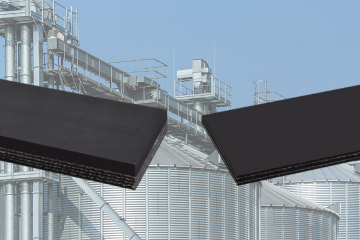
150 to 600 PIW
From 2-ply 150 PIW belts to 3-ply 600 PIW, with top covers from 1/32" to 3/8".
Oil resistant
Moderate Oil Resistant (MOR) and Super Oil Resistant (SOR) covers, including hot asphalt service.
Flame and static
Flame-resistant, static-conductive belts for grain handling and dusty areas.
High heat
EPDM covers for material up to 400 °F, and EPM covers for peaks up to 700 °F.
Start here: which heavy duty belt do you need?
Choose by what the belt carries. Each link opens the matching belts in the store.
| If the belt carries… | Look at | Why |
|---|---|---|
| Sand, gravel, aggregate or general bulk | Grade 2 (SBR) | General-purpose rubber with good abrasion resistance, 150 to 600 PIW |
| Wood, lumber or sharp, wet material | Grade 2, pure gum covers | Tan natural rubber: resilient and cut resistant |
| Oily grain, wood chips or material with some oil | Moderate Oil Resistant (MOR) | Moderate oil resistance for material with some oil in it |
| Grain, where static build-up is a concern | MOR, static conductive | Moderate oil resistance plus a static-conductive cover |
| Grain in dusty areas where fire and static are a concern | Flame resistant, static conductive | Flame-resistant, static-conductive and oil-resistant covers, 220 to 600 PIW |
| Heavy oil exposure or hot asphalt | Super Oil Resistant (SOR) | Nitrile cover rated from -10 °F to 300 °F |
| Hot material | High heat | EPDM to 400 °F, or EPM for peaks up to 700 °F |
| Bulk material on an incline | Incline belting | Cleated, multi-chevron and mini-cleat tops hold material on the slope |
| Boxes, packages or light product, not bulk | Light duty belting | Thinner, more flexible belts that run on smaller pulleys |
What heavy duty belting is
Heavy duty versus light duty
Heavy duty belting is built to survive the material : thicker rubber covers that absorb impact and wear, on 2 to 4 fabric plies rated 150 to 600 PIW. It needs larger pulleys, 6" to 24" depending on the belt. Light duty belting is built to carry product : thin covers or none, 35 to 280 PIW, on pulleys as small as 0.75". If lumps drop onto the belt, or the material is sharp or abrasive, you want heavy duty. For boxes and packaged goods, see light duty belting.
Top cover, bottom cover
The top cover takes the wear, so a thicker top cover lasts longer on abrasive material. Our heavy duty top covers run from 1/32" to 3/8". The underside is either a thinner rubber cover, which protects the fabric where it runs over idlers and pulleys, or bare fabric.
How PIW works
PIW is pounds per inch of width: the working tension one inch of belt width is rated to carry. A 220 PIW belt run 24" wide is rated for about 5,280 lb of working tension. Longer conveyors, heavier loads and steeper inclines need more tension. See What is PIW? for more, and the conveyor horsepower guide to estimate your drive.
How to read a heavy duty belt name
A belt's name is its spec in shorthand. Here is one taken apart.
- 3-PLY: three layers of fabric inside the belt carry the load.
- 330# PIW: rated working tension, 330 lb per inch of belt width.
- BLACK: the cover color.
- 3/16 X 1/16: 3/16" of rubber on top, 1/16" underneath.
- HR 400°F: heat-resistant cover for material up to 400 °F.
Cover compounds
| You see | Cover | Choose it for | Temperature range |
|---|---|---|---|
SBR
|
Styrene-butadiene rubber (Grade 2) | General bulk handling; good abrasion resistance, not oil resistant | -25 °F to 225 °F |
PURE GUM
|
Natural rubber | Wood and lumber; resilient and cut resistant | -25 °F to 225 °F |
MOR
|
Moderate Oil Resistant | Oily grain, wood chips and material with some oil | -25 °F to 225 °F |
SOR
|
Super Oil Resistant (nitrile) | Heavy oil exposure, including hot asphalt | -10 °F to 300 °F |
FR
/ SC
|
Flame resistant / static conductive | Grain handling and dusty areas where fire and static are a concern | -25 °F to 225 °F |
HR 400°F
|
EPDM | Hot material up to 400 °F | -20 °F to 400 °F |
PEAK HR 700°F
|
EPM | Hot material with peaks up to 700 °F | -20 °F to 700 °F |
Every belt's page in the store has its own "What the name means" table.
The heavy duty belt types
Each button opens that type in the store, with every belt's specs, width options and a quote button.
Grade 2
- Rated tension 150 to 600 PIW
- Plies 2 to 4
- Smallest pulley 6" to 24"
General bulk handling, sand and gravel, mining and package handling, plus tan pure gum belts for wood and lumber.
Shop Grade 2Moderate Oil Resistant
- Rated tension 160 to 600 PIW
- Plies 2 to 3
- Smallest pulley 6" to 24"
For oily grain, wood chips and material with some oil in it.
Shop MORMOR, Static Conductive
- Rated tension 220 to 330 PIW
- Plies 2 to 3
- Smallest pulley 16" to 18"
Moderate oil resistance with a static-conductive cover, for grain handling.
Shop MOR/SCFlame Resistant, Static Conductive
- Rated tension 220 to 600 PIW
- Plies 2 to 3
- Smallest pulley 16" to 24"
Flame-resistant, static-conductive and oil-resistant covers for grain, plus a flame-resistant SBR belt for mining and power plants.
Shop FR/SCSuper Oil Resistant
- Rated tension 220 to 330 PIW
- Plies 2 to 3
- Temperature -10 °F to 300 °F
Nitrile covers for heavy oil exposure, built for hot asphalt.
Shop SORHigh Heat
- Rated tension 220 to 440 PIW
- Plies 2 to 4
- Rated to 400 °F, or 700 °F peak
Heat-resistant covers for hot material coming off ovens and other hot processes.
Shop High HeatHeavy duty incline belts (cleated, multi-chevron and mini-cleat) are grouped with all our incline belts: shop incline belting or read the incline guide. Popular heavy duty belts are also stocked as ready-to-ship 24" and 36" x 100 ft rolls.
Cut, joined and shipped to your size
Every belt is cut to order, and we can finish it before it ships. Finishing is quoted to order, because sizes and options vary. Tell us your application requirements and we will recommend the right setup.
- Cut to size Your width and your length.
- Mechanical lacing Installed. Each belt's store page lists the lacing that suits it.
- Endless splicing Vulcanized or glued, for a seamless loop.
- Cleats and sidewalls Added to your dimensions.
- V-guides Bonded to the underside to help the belt track.
Lacing it yourself? Fasteners, splice kits and adhesives are on our belting accessories page.
Further reading
Heavy duty conveyor belting guide
An overview of heavy duty constructions and where they are used.
A buyer's guide to heavyweight belts
What to weigh when you choose a heavy belt.
High temperature belting options
Heat-resistant belting for hot material.
Heavy duty belting FAQ
What does PIW mean on a heavy duty belt?
PIW stands for pounds per inch of width: the belt's rated working tension. A 220 PIW belt 24" wide is rated for about 5,280 lb of working tension. Our heavy duty belts are rated 150 to 600 PIW. Longer conveyors, heavier loads and steeper inclines need higher ratings.
How many plies do I need?
Our heavy duty belts have 2 to 4 plies. More plies generally means a higher tension rating and a stiffer belt that needs larger pulleys: our heavy duty belts need pulleys from 6" to 24". Match the tension rating and the pulley size of your conveyor first. Send us your material, belt width and conveyor length and we will help you choose.
SBR, MOR or SOR: which cover do I need?
SBR (Grade 2) is general-purpose rubber with good abrasion resistance, for dry bulk material. MOR, Moderate Oil Resistant, is for material with some oil, such as oily grain and wood chips. SOR, Super Oil Resistant, is a nitrile cover for heavy oil exposure, including hot asphalt. Using a cover that is not oil resistant around oil lets the rubber swell and wear early.
When do I need flame-resistant, static-conductive (FR/SC) belting?
Where combustible dust and static build-up are a concern, such as grain handling. Flame-resistant covers resist burning, and static-conductive covers bleed off static charge. Check the requirements that apply to your site before you order; we can help you match a belt to them.
How hot can high-heat belting run?
Our EPDM covers are rated for material up to 400 °F. Our EPM covers are rated for peak material temperatures up to 700 °F. Both run from -20 °F. Choose the 400 °F belts for steady heat and the 700 °F belts where the material runs hotter.
How thick should the top cover be?
The top cover takes the wear, so a thicker cover lasts longer on abrasive or heavy material. Our heavy duty top covers run from 1/32" to 3/8". Each belt's name gives the top and bottom cover thickness, for example 3/16 X 1/16.
Can you cut a belt to length and make it endless?
Yes. Every belt is cut to the width and length you order. We can also install mechanical lacing, splice it endless (vulcanized or glued), and add cleats, sidewalls or V-guides. Finishing is quoted to order; tell us your application requirements.
Do you stock ready-to-ship heavy duty belt?
Yes. Popular heavy duty belts are stocked as 24" and 36" wide x 100 ft rolls in our quick ship category. Any belt can also be cut to your own width and length.
Can you match a belt I already have?
Usually. Send the name printed on the old belt, or a photo with its width, thickness and ply count, and we will find the closest current belt.
Not sure which belt you need?
Send the material, the width and length, and a photo of the old belt if you have one. We will come back with a recommendation, not just a price.