Belt conveyor motor sizing errors fall into two categories. Oversizing wastes energy across the motor's entire service life; undersizing drives thermal overload, nuisance tripping, and premature failure. Both usually trace to the same root cause—effective tension calculated without accounting for drive-train losses, or calculated from a simplified catalog formula that omits the return run. The CEMA method removes that ambiguity by defining each resistance component explicitly.
Fundamentals of Conveyor Power and Effective Tension
Calculating the required horsepower for a belt conveyor begins with understanding the relationship between power, tension, and speed. Horsepower (HP) is the rate at which work is done. In a conveyor system, it is the power required to move the belt and its load against the total resistance of the system.
- Effective Tension (Te) is the critical value in this calculation. It represents the sum of all forces that the drive must overcome to move the belt and material. These forces include friction, gravity (lift), and material acceleration.
- The Conveyor Equipment Manufacturers Association (CEMA) provides the industry-standard methodology for these calculations, detailed in their publication, Belt Conveyors for Bulk Materials, 7th Edition. This guide ensures a comprehensive and consistent approach.
- Power requirements can be broken down into two main parts: the power needed to run the conveyor empty and the additional power needed to move the load. The CEMA method accounts for both.
The Basic Horsepower Formula
The fundamental relationship between effective tension, belt speed, and horsepower is expressed in a straightforward formula. For any calculation, it's essential to have accurate data, which you can determine using our online
Calculators — including a dedicated
conveyor belt calculator for speed and capacity inputs.
HP = (Te × V) / 33,000
Where:
- HP is Horsepower
- Te is Effective Tension in pounds (lb)
- V is Belt Velocity in feet per minute (FPM)
- 33,000 is the conversion factor (1 HP = 33,000 ft-lb/minute)
The metric equivalent is expressed in kilowatts (kW), where power is the product of tension in Newtons (N) and velocity in meters per second (m/s).
kW = (Te [in N] × V [in m/s]) / 1,000
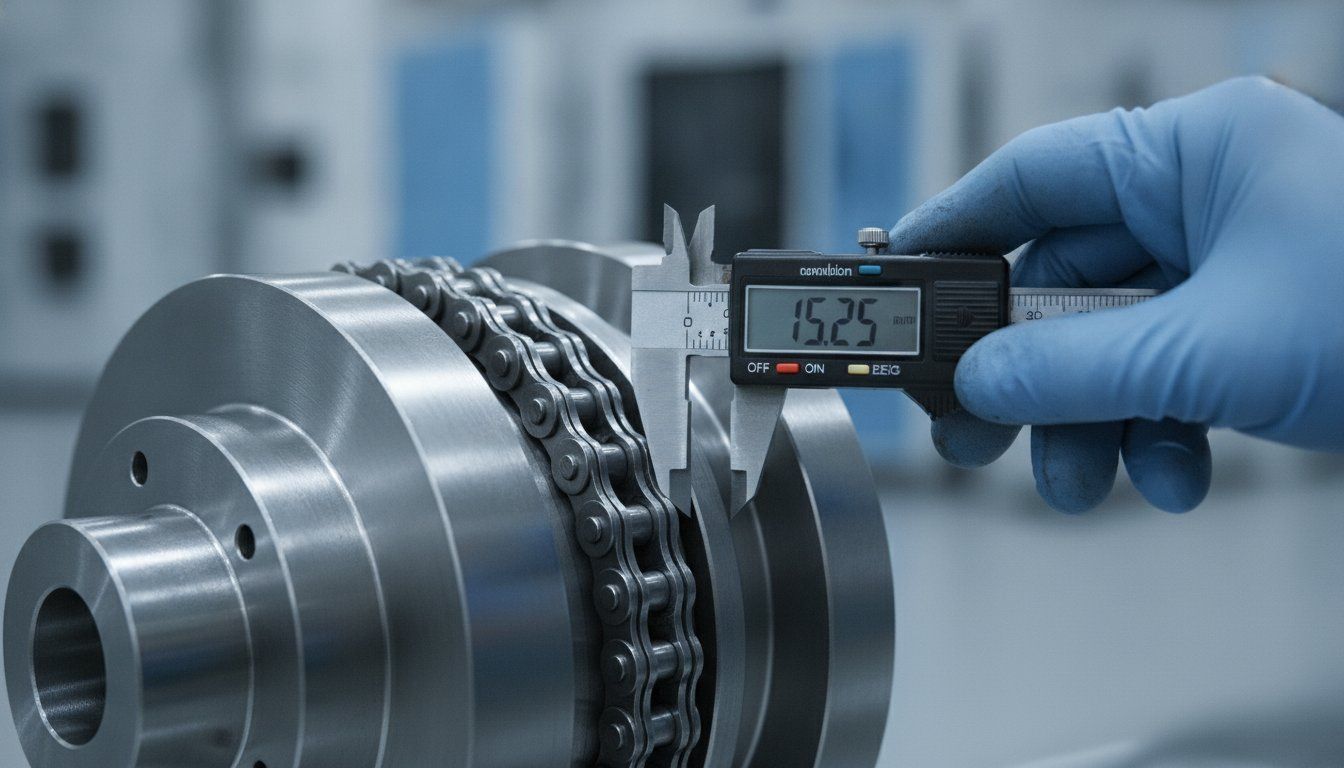
Belt speed shouldn't be estimated. Verify it with a digital tachometer, or calculate it from measured drive pulley diameter and shaft RPM—V = π × D × RPM. A
Pi Tape gives the pulley diameter to 0.001 in., which removes the largest source of error in that calculation.
Primary Resistance Variables
Effective Tension (Te) is the sum of multiple resistances within the conveyor system. The main variables include:
- Internal Friction: Resistance generated by the moving components of the conveyor itself, including idlers, pulleys, and bearings. This is present even when the conveyor is empty.
- Material Friction: Drag caused by the conveyed material interacting with system components like skirtboards and belt scrapers.
- Component Weight: The weight of the
Conveyor Belting and moving parts (like idler rolls) contributes significantly to the frictional drag on both the carrying and return sides of the conveyor.
The CEMA Method: Calculating Effective Tension (Te)
The CEMA method provides a structured way to calculate Te by breaking it down into its constituent parts. This ensures no major resistance is overlooked. The total effective tension is the sum of forces required to overcome friction, move the load horizontally, and lift the load vertically.
- The friction factor (f) is a key variable that accounts for the rolling resistance of the idlers and the sliding resistance of the belt. It can vary based on ambient temperature, idler lubrication, and overall maintenance condition.
- The calculation must respect the belt's tension rating, commonly expressed in Pounds per Inch of Width (PIW). Exceeding this limit can damage or destroy the belt. You can learn more in our guide,
What is PIW.
- Accurate weight-per-foot data for both the belt (Wb) and the conveyed material (Wm) is non-negotiable for an accurate calculation.
Calculating Friction and Horizontal Resistance
The first component of Te is the tension required to overcome friction. This includes the friction of the empty belt and the friction of the material load.
- The friction resistance of an empty conveyor is calculated as Tf = L × f × (2Wb + Wi), where L is the conveyor length, f is the friction factor, Wb is the belt weight per foot, and Wi is the weight of rotating idler parts per foot. The belt weight is doubled because the belt is present on both the carrying and return runs. This friction term is one of three components summed to produce Te.
- Next, the resistance from moving the material horizontally is added. This is calculated as L × f × Wm.
- Finally, account for additional drag from
Belting Accessories like belt cleaners, plows, and skirtboard seals. CEMA provides standard values for these resistances.
Accounting for Vertical Lift and Incline
When a conveyor is inclined, gravity becomes a primary force that the drive must overcome. This component of tension is often the largest in incline applications.
- For systems using
Incline Conveyor Belting, the power to lift the material is calculated directly from the change in elevation (H) and the material weight (Wm).
- The formula for lift tension is simply H × Wm. This force is independent of friction and belt speed; it is purely a function of mass and vertical distance.
- It is important to distinguish between "uphill" (power-consuming) and "downhill" (regenerative) conveyors. A downhill conveyor may generate power, requiring a braking system or a regenerative drive to control its speed and stop safely.
Incorporating Drive Efficiency and Safety Factors
The horsepower calculated from the Te formula (HP = Te × V / 33,000) is the power required at the drive pulley. However, no drive system is 100% efficient. The motor must be sized to account for mechanical and electrical losses in the drivetrain.
- Drive Efficiency (e) is the product of the efficiencies of all components between the motor and the drive pulley. This typically includes the motor itself and the speed reducer (gearbox). The final motor HP is the calculated HP divided by the total drive efficiency (e.g., HPmotor = HPpulley / e).
- Start-up conditions, especially with a fully loaded belt, can require significantly more torque than steady-state running. A "Service Factor" is often applied to account for this.
- NEMA standards for
Electric Motors provide detailed information on torque curves (e.g., NEMA Design B vs. Design C) that define a motor's starting torque capability.
Speed Reducer and Gearbox Efficiency
The choice of speed reducer has a major impact on overall drive efficiency and, consequently, the final motor size. Our
gearbox ratio calculator can help you confirm the reduction you need before efficiency is applied.
- Helical and Bevel Gearboxes: These are highly efficient, typically operating at 95-98% efficiency per stage of reduction. They are the standard for most industrial conveyor applications.
- Worm Gearboxes: While compact and often lower in initial cost, worm gearboxes are significantly less efficient, with typical efficiencies ranging from 60% to 80%. This efficiency loss translates directly into higher energy consumption and may require a larger motor.
- The selection of
Gearing Products and
Shaft Couplings directly influences the final power transmission efficiency and reliability of the system.
Environmental and Safety Factors
Beyond mechanical efficiency, operational conditions and safety margins must be considered.
- High ambient temperatures or high-altitude operations can reduce a motor's ability to cool itself, effectively de-rating its power output. Manufacturers provide charts for these adjustments.
- A safety factor (typically 1.1 to 1.2, or 10-20%) is often added to the final calculated horsepower. This accounts for minor miscalculations, unexpected load surges, or gradual increases in friction as components wear over time.
- A Service Factor is a multiplier specified by the motor manufacturer that indicates the motor's ability to handle an occasional overload beyond its nameplate rating without damage.
Step-by-Step Horsepower Calculation Example
Let's walk through how to calculate required horsepower for a belt conveyor using a common industrial scenario.
- Conveyor Length (L): 100 feet
- Incline: 20 degrees
- Material Load (Wm): 50 lbs per foot
- Belt Speed (V): 100 feet per minute (FPM)
Imperial Calculation Walkthrough
Based on the CEMA methodology for the scenario above, the components of tension are calculated and summed. Vertical lift dominates this example: a 100 ft conveyor at 20° rises 34.2 ft, so lift tension = 50 lb/ft × 34.2 ft ≈ 1,710 lb. Friction across the carrying and return runs adds roughly 250 lb. Skirtboard and cleaner drag accounts for the remainder, giving a total effective tension of approximately 2,000 lb (≈8.9 kN).
- Calculate Pulley HP: HP = (Te × V) / 33,000 HP = (2,000 lb × 100 FPM) / 33,000 HP ≈ 6.06 HP
- Apply Drive Efficiency: Assume a total drive efficiency of 90% (0.90) for a helical gearbox and premium efficiency motor. Required Motor HP = 6.06 HP / 0.90 Required Motor HP ≈ 6.73 HP
- Select Motor Size: The next standard NEMA motor size up from 6.73 HP is 7.5 HP.
Metric Conversion Walkthrough
Let's convert the same scenario to metric units to demonstrate the process for international applications.
- Length: 100 ft ≈ 30.5 m
- Material Load: 50 lb/ft ≈ 74.4 kg/m
- Belt Speed: 100 FPM ≈ 0.508 m/s
- Effective Tension: 2,000 lb ≈ 8,896 N
- Calculate Pulley kW: kW = (Te [N] × V [m/s]) / 1,000 kW = (8,896 N × 0.508 m/s) / 1,000 kW ≈ 4.52 kW
- Apply Drive Efficiency: Using the same 90% efficiency: Required Motor kW = 4.52 kW / 0.90 Required Motor kW ≈ 5.02 kW
- Select Motor Size: The next standard IEC motor frame size up from 5.02 kW is 5.5 kW.
Sourcing the Right Motor and Drive Components
As an independent distributor founded in 1950, Jealco is not tied to a single manufacturer. This allows us to source the optimal motor, gearbox, and belting combination for your specific application from a global network of suppliers. With over 75 years of export experience, we manage the complexities of international logistics for projects across 6 continents.
Whether you need
Heavy Duty Conveyor Belting and a matching high-torque motor for a mining application or are trying to cross-reference a discontinued component, our team can assist. We specialize in finding the exact parts needed to keep your operations running. If you are specifying new motors, note that DOE efficiency standards take effect for motors manufactured on or after June 1, 2027, raising ODP, TEFC, and explosion-proof motors in the 100–250 HP range to NEMA Premium 4 (IE4).
What to Send Us for a Quote
To provide an accurate and timely quote for a replacement motor or new drive package, please include the following information:
- Motor Data: Required HP or kW, RPM, voltage, phase, frame size, and enclosure type (e.g., TEFC, ODP, Explosion-Proof).
- Conveyor Specs: Belt width, PIW requirement, and center-to-center distance of the conveyor.
- For Replacements: A clear photo of the existing motor's nameplate is the most effective way to ensure a perfect match.
Consultative Sourcing for Global Operations
Jealco's expertise extends beyond component supply. We provide consultative support for global operations, handling customs documentation and logistics to ensure your parts arrive on schedule. Our approach is to serve as a technical partner, helping you verify calculations and source the most reliable and efficient components for your system.
For expert assistance with your horsepower calculations or to source conveyor drive components,
contact our technical team today.
Frequently Asked Questions (FAQs)
What is the most common mistake in conveyor horsepower calculation? The most common error is neglecting one of the key components of effective tension. This often involves using a simplified "rule-of-thumb" formula that only accounts for the material load and lift, while completely ignoring the friction from the belt, idlers, and accessories, especially on the return run.
How does belt incline affect the required motor power? Incline has a dramatic effect. The power required to lift the material (tension due to gravity) is often the largest single component of the total power calculation. This component is directly proportional to the vertical height the material is lifted, so even a few degrees of incline can significantly increase the required horsepower compared to a horizontal conveyor.
Can I use a smaller motor if I use a variable frequency drive (VFD)? No. A VFD controls the speed of the motor, but it does not increase its fundamental power or torque capability. The motor must still be sized to handle the maximum torque required by the application, which usually occurs at start-up with a full load. A VFD can provide a "soft start" to reduce mechanical shock, but the motor itself must be powerful enough for the job.
What is the difference between running HP and start-up HP? Running HP is the power required to keep the conveyor moving at a steady speed under a normal load. Start-up HP (or more accurately, starting torque) is the force needed to overcome inertia and static friction to get a fully loaded, stationary belt moving. This often requires 150-200% of the motor's full-load running torque, which is why NEMA motor designs (e.g., Design C for high starting torque) are a critical consideration.
How does drive efficiency change between different types of gearboxes? Efficiency varies significantly. High-efficiency helical or bevel gear reducers typically operate at 95-98% efficiency. In contrast, right-angle worm gearboxes are much less efficient due to the sliding friction between the worm and the gear; their efficiencies may drop to 60–80%, depending on the ratio. This loss is converted directly into heat and wasted energy.
Why is Effective Tension (Te) more important than total belt weight? Total belt weight is only one factor that contributes to frictional drag. Effective Tension (Te) is the comprehensive sum of all resistances the drive must overcome—including friction from the belt and idlers, the force to lift the material against gravity, and drag from accessories like skirtboards and cleaners. Te is the true measure of the work the motor must perform.
How do I calculate horsepower for a downhill or regenerative conveyor? For a downhill conveyor where the force of gravity on the load exceeds the system's friction, the calculation is done the same way, but the lift tension component becomes a negative value. This results in a negative Te, indicating the conveyor will try to run away. The motor and drive must be sized to provide controlled braking (holding back the load) rather than motive power. Proper sizing ensures the system meets ASME B20.1 requirements for controlled stopping, especially when handling heavy loads on steep declines.
Does the type of conveyor belt material affect the friction factor? Yes, but indirectly. The CEMA friction factor (f) is primarily intended to account for the rolling resistance of the idler bearings and the flexure of the belt as it moves over them. While the belt's cover compound itself doesn't drastically change this value, the belt's overall construction, stiffness, and weight (Wb) are direct inputs into the friction calculation, so selecting the correct belt is critical.