Short answer:
A Numatics Mark 8 part number describes the whole valve: port size, solenoid type, valve function, mounting, wiring, port thread, options and coil voltage, in that order. Decode it with the catalog for that series, then make sure any replacement matches six things: function, port size and thread, Cv, actuation, coil voltage, and mounting. A valve that matches five of the six will not do the job.
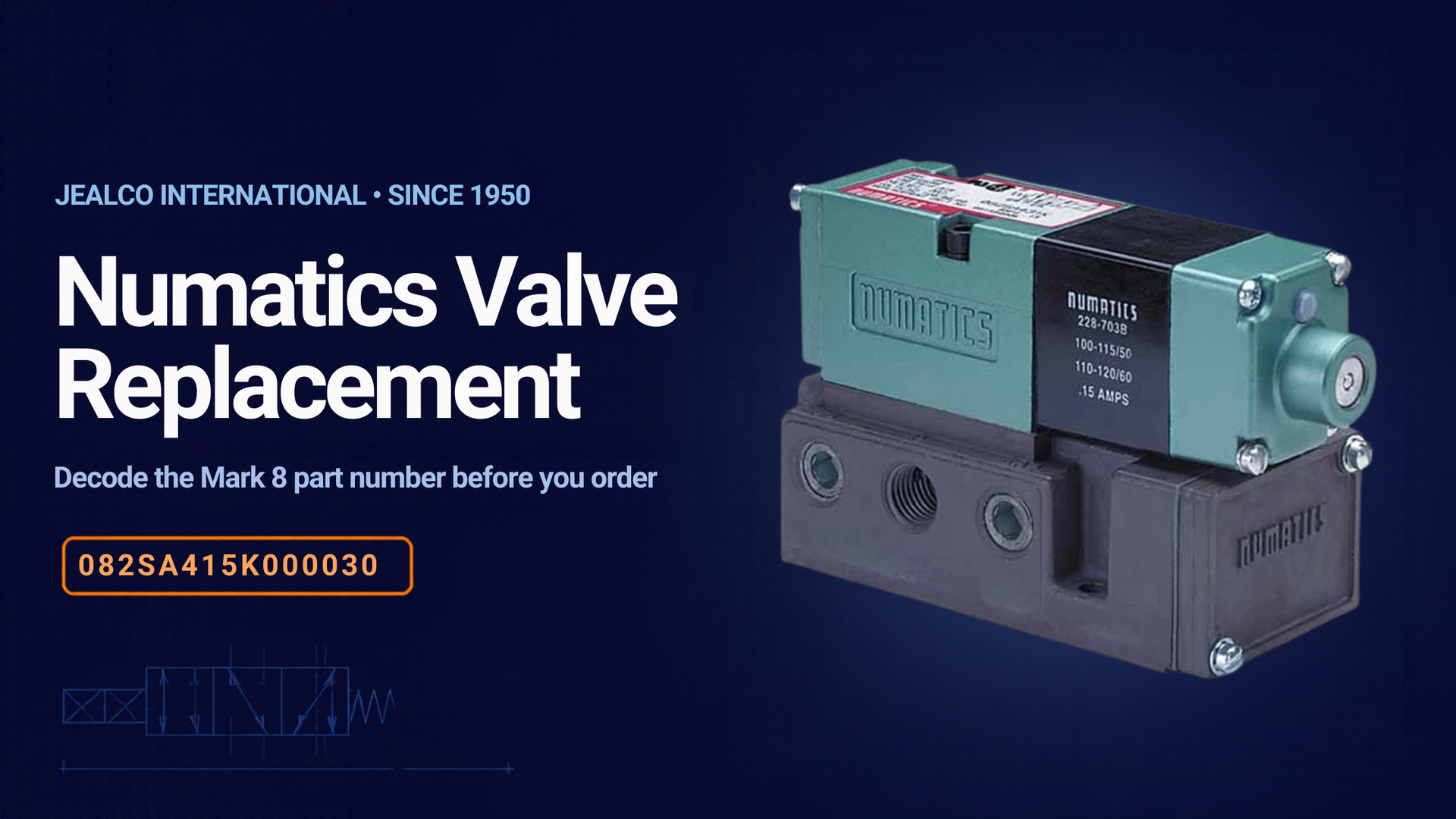
Numatics valves are still installed on a great many machines, but the name on the label has changed. Emerson acquired Numatics in 2005 and combined it with ASCO in 2008, so labels and literature may read Numatics, ASCO Numatics or ASCO. The Mark 8 catalog Emerson publishes today is still the Numatics catalog, with the same part-number key.
The usual trouble with a Numatics valve replacement is not finding a valve. It is finding one that looks right and differs in one field: a G-threaded body for an NPT system, a DC coil for an AC panel, or a closed-center valve where the circuit needs open center. This guide decodes a real Mark 8 part number and then works through each field a replacement must match.
Decoding a Mark 8 part number
The Numatics Mark 8 Series catalog uses 082SA415K000030
as its ordering example. Read left to right:
| Code |
Field |
Meaning in this example |
Other catalog options |
| 082 |
Valve series and port size |
Mark 8, 1/4 in ports |
081 = 1/8 in |
| SA |
Valve type |
Single direct solenoid, spring return, flush non-locking override |
SS = double direct solenoid |
| 4 |
Function |
2-position, 4-way (5/2) |
5 = 3-position 4-way (5/3), open center, dual pressure; 6 = 3-position 4-way (5/3), blocked center |
| 15 |
Mounting |
Manifold block with side and bottom cylinder ports |
00 = valve unit only; 31 = plug-in base, common exhaust, side cylinder ports; 3A = plug-in base, individual exhaust, side cylinder ports; others with speed control or bottom ports |
| K |
Wiring option |
Plug-in, AC, with light |
M = plug-in DC with light; 2 = DIN plug-in AC; 4 = DIN plug-in DC |
| 0 |
Port type |
NPTF pressure ports |
G = ISO 228/1-G pressure ports |
| 000 |
Options |
None |
Locking overrides, longer leads, DC surge suppression, terminal block and others |
| 30 |
Voltage |
110–120 V AC, 50–60 Hz |
20 = 24 V AC; 40 = 220–240 V AC; 60 = 12 V DC; 61 = 24 V DC |
Two fields cause most wrong orders. The port type is a single character
near the end, so 082SA415K000030 and 082SA415KG00030 look almost identical (0 or G in the tenth position) but have different threads. And the voltage is the last two digits, so a part number copied without its final characters says nothing about the coil.
This key applies to Mark 8 only. Mark 3 valves, and the Numatics ISO 5599-2 and ISO 15407-2 series, each have their own catalog and code layout. Identify the series from the label before decoding, and do not apply one series' key to another.
1. Valve function
Function is written as ports/positions. A 2/2
valve opens or closes one flow path. A 3/2
valve pressurizes and exhausts one outlet, typical for a single-acting cylinder or a pilot signal. A 5/2
valve drives a double-acting cylinder in both directions. A 5/3
valve adds a center position, and the center condition decides what the cylinder does when neither solenoid is energized.
In an open-center valve, the cylinder ports are connected to exhaust in the center position, so the cylinder can be moved by hand or by the load. In a blocked (closed) center valve, all ports are blocked and air is held in the cylinder. Swapping one for the other changes how the machine behaves at a stop, which is a safety question, not just a fit question. Mark 8 is a 5-ported, 4-way valve in 2- and 3-position forms; a 2/2 or 3/2 requirement points to a different valve family.
2. Port size and thread type
Port size and thread type are separate fields. NPT and NPTF threads are standard in North America; BSPP (G, ISO 228-1) is standard in most other markets. They do not interchange: a G fitting will not seal in an NPTF port. In the Mark 8 code, the size is in the first three digits (081 or 082) and the thread is the single port-type character (0 = NPTF, G = ISO 228/1-G).
This matters most when a machine built in one region is serviced in another. Read the thread from the part number, not from the fittings installed in it, since an adapter may already be in the line.
3. Cv: flow coefficient
Cv is the flow of water, in US gallons per minute at 60°F, that passes through a valve with a 1 psi pressure drop. For air valves it is the standard way to compare flow capacity between makes and sizes. A replacement should have a Cv equal to or higher
than the original; a lower Cv slows the cylinder.
Port size alone does not tell you Cv. The Mark 8 catalog lists Cv 0.80 for the 1/8 in body and 1.0 for the 1/4 in body, with flow of 37 and 46 SCFM at 80 psig upstream to atmosphere. A different maker's 1/4 in valve can have a noticeably higher or lower figure. Take the Cv from the candidate's own catalog, not from its port size.
4. Actuation
A single-solenoid, spring-return valve (SA in the Mark 8 code) returns to its normal position whenever the coil is de-energized, including on a power loss. A double-solenoid 2-position valve (SS) stays in its last position until the opposite coil is energized. The two are not interchangeable without changing the control logic, because the machine's response to a power loss changes. Pilot-operated and air-piloted valves are a further variation; check the label and the catalog for the series in question.
5. Solenoid voltage, AC or DC
The coil must match the control voltage and current type. An AC coil on a DC supply, or a 24 V coil on 120 V, will fail quickly or not shift the valve at all. In the Mark 8 code, the last two digits set the voltage, and the wiring letter sets AC or DC and the connector style: K and M are plug-in with an indicator light (AC and DC), 2 and 4 are DIN plug-in (AC and DC).
For export, also confirm the supply frequency. The Mark 8 AC coils are rated 50–60 Hz, but not every maker's AC coil is dual-frequency, so a cross-brand replacement shipped to a 50 Hz country needs that checked.
6. Mounting
An inline valve is piped directly into its own body ports. A sub-base or plug-in base valve sits on a separate base that carries the piping, and a manifold valve sits on a shared block with neighbors. The Mark 8 catalog offers all three: valve unit only (mounting 00), individual plug-in bases (31 to 3D), and manifold blocks (15 to 1B).
On a plug-in base, the electrical connection is made through the base, so a failed valve unit can be replaced without disconnecting the piping or wiring. If the base and manifold are sound, the replacement may be the valve unit alone, which is a smaller and cheaper order than a complete assembly.
Crossing to another brand: where ISO 5599 helps
ISO 5599-1 and ISO 5599-2 standardize the mounting interface of five-port directional control valves, without and with an integrated electrical connector. Valves built to the same part and size share the same bolt pattern and port layout, so on an ISO sub-base, one maker's valve can usually replace another's without re-piping. That is the simplest cross-brand replacement there is. Function, Cv, actuation and coil voltage still have to match.
The Mark 8 catalog describes Numatics' own plug-in bases and manifold blocks, not an ISO 5599 interface. Moving a Mark 8 position to another brand therefore usually means replacing the base or manifold as well, and re-piping that station. Where only the valve has failed, a Mark 8 replacement is normally the faster route.
What to send us for a valve replacement
- The full part number, every character, exactly as printed. Mark any character you cannot read rather than guessing it.
- A photo of the label
and one of the valve on its base or manifold.
- The coil voltage, AC or DC, and the supply frequency (50 or 60 Hz).
- The port size and thread: NPT or BSPP/G.
- The mounting: inline, sub-base, plug-in base or manifold, and whether you need the valve unit only or the base as well.
Frequently asked questions
Are Numatics valves still available?
Yes. Numatics is part of ASCO, an Emerson brand, and Emerson still lists the Numatics Mark 8 and Mark 3 series.
Can I replace a Mark 8 valve with another brand?
Usually only by replacing the base or manifold as well, because Mark 8 uses Numatics' own mounting rather than an ISO 5599 sub-base.
What does the "K" in a Mark 8 part number mean?
It is the wiring option: a plug-in connection for an AC coil, with an indicator light. "M" is the DC equivalent.
Summary
Decode the full part number with the catalog for its own series, then check the six fields one by one: function and center condition, port size and thread, Cv, actuation, coil voltage and frequency, and mounting. Like-for-like is simplest for Mark 8; ISO 5599 valves are the easiest to cross between brands.
Sources & References
- Numatics, Mark 8 Series
valve catalog (LT-Mark8Series Rev 2/14), "How to Order" and "Technical Data". Product page: Emerson, Numatics Series Mark 8 Directional Control Valves.
- ISO 5599-1:2001, Pneumatic fluid power — Five-port directional control valves — Part 1: Mounting interface surfaces without electrical connector; ISO 5599-2:2001, Part 2: with electrical connector.
Send us the part number, coil voltage and port details and we will confirm a direct replacement or a cross from our pneumatic components
lines.
Related Reading: