
Optimizing Elevator Bucket Venting for Fine Materials
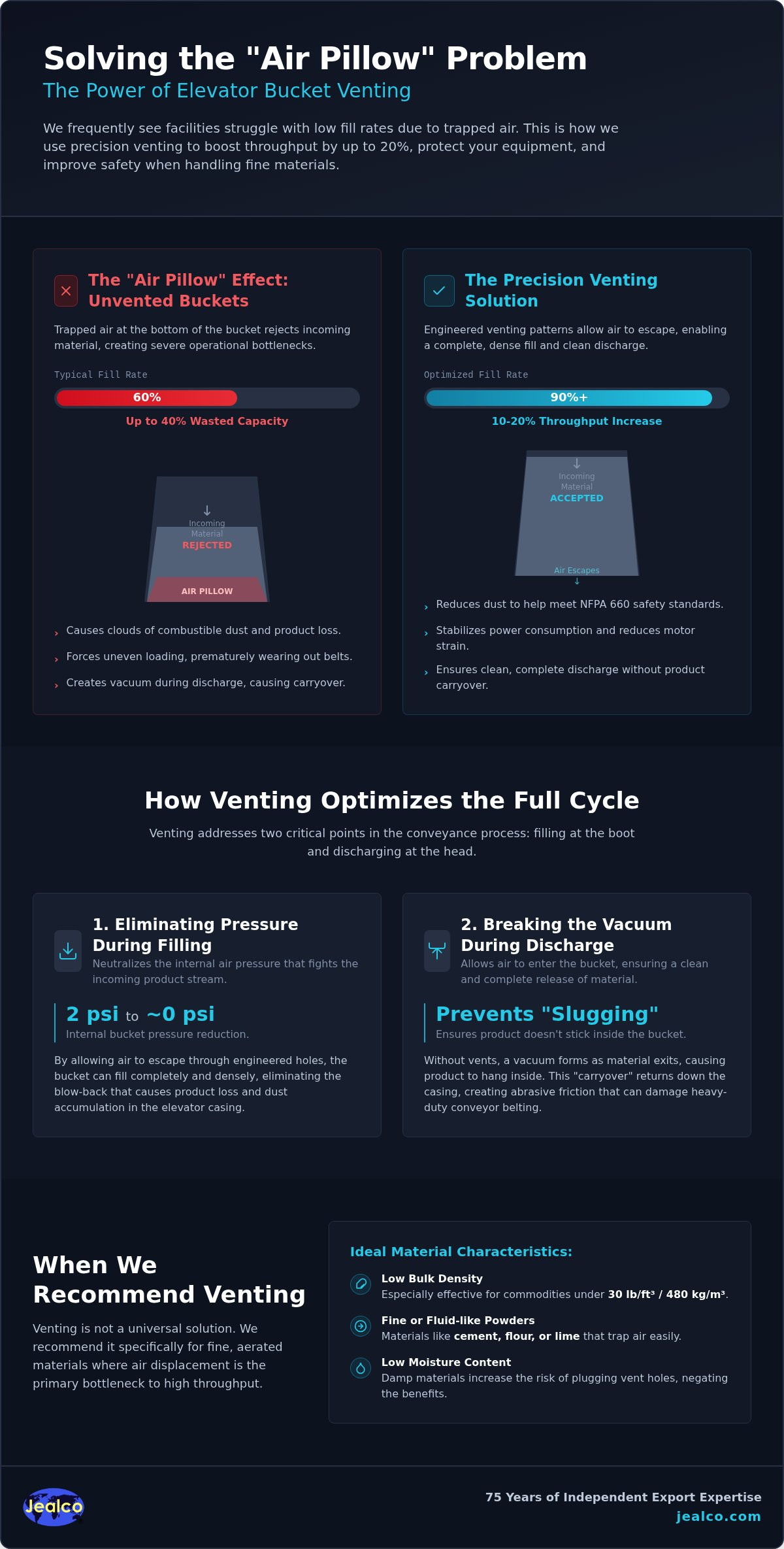
Your bucket elevator might be running at high speed, but if you are moving powders, you are likely transporting more air than product. We frequently see facilities struggling with a 60% fill rate because trapped air creates a "pillow" that rejects incoming material. This air displacement doesn't just cut your throughput. It creates clouds of dust and forces uneven loading that wears out your belts prematurely.
We will show you how precision elevator bucket venting for fine materials can eliminate these operational bottlenecks. Our guide explains how to achieve a 90% or higher bucket fill while ensuring a clean discharge without vacuum-induced carryover. In our experience, engineered venting patterns are the primary tool for meeting the new NFPA 660 safety standards for combustible dust while protecting your equipment.
We'll break down the technical differences between standard 1/8 inch (3.175 mm) holes and custom patterns up to 3/8 inch (9.525 mm). We also examine how proper venting reduces the internal pressure that leads to material blow-back. This technical overview provides the data you need to optimize your vertical conveyance for maximum profitability.
Key Takeaways
- Eliminate the "air pillow" effect where trapped air at the bottom of the bucket (0.125 in / 3.17 mm) prevents fine powders from filling the available volume.
- Discover how specialized elevator bucket venting for fine materials increases throughput by 10% to 20% through more dense material packing and improved air evacuation.
- Identify why high-density commodities like cement or lime require specific Pattern #4 or #5 venting to ensure rapid air release and a clean discharge without carryover.
- Reduce mechanical stress and motor surging by ensuring uniform bucket loading, which protects your heavy-duty conveyor belting and stabilizes power consumption.
- Learn to source the ideal bucket material-whether polyethylene, nylon, or steel-based on your specific application requirements rather than brand-specific limitations.
The Physics of Air Displacement in Fine Material Handling
When we analyze high-speed bucket elevators handling fine powders, we frequently observe the "Air Pillow" effect. We define this phenomenon as the physical resistance created when material enters the bucket at a velocity that exceeds the rate at which air can escape. Because fine powders like cement or flour act as fluids rather than solids, they trap a layer of air at the bottom of the bucket. In our experience, this trapped air layer typically reaches a depth of 0.125 in / 3.17 mm, significantly reducing the usable volume of each bucket.
Without proper venting, this trapped air has nowhere to go but up through the incoming material stream. This creates intense turbulence and significant "blow-back" during the filling stage at the boot. We see this lead to material being ejected back into the elevator casing, which causes dust accumulation and product loss. As the buckets transition from the boot to the head section, centrifugal forces compress these air pockets further, making the material less stable during transit.
The high-speed rotation during this transition intensifies the internal pressure within the bucket cavity. We have found that compressed air pockets can occupy up to 40% of the bucket's theoretical volume if they aren't managed correctly. This reduces the effective capacity of your entire system. It also forces your motor to consume more energy to move a smaller volume of product, which decreases your overall operational efficiency.
Breaking the Vacuum During Discharge
Efficient discharge is just as critical as efficient filling for maintaining high throughput. As material attempts to exit the bucket at the head section, a vacuum naturally forms at the bottom of the bucket. This vacuum creates a "slugging" effect where the product hangs inside the bucket instead of discharging cleanly. This leads to carryover, where material returns down the casing and potentially damages your heavy-duty conveyor belting through abrasive friction. Vent holes allow atmospheric pressure to equalize and release the load instantly by breaking this suction.
Material Characteristics That Mandate Venting
Not every material requires the same level of aeration to flow correctly. We recommend elevator bucket venting for fine materials specifically when you are handling commodities with a low bulk density under 30 lb/ft³ / 480 kg/m³. Particle size, measured in microns, also determines how much air becomes entrapped during the loading cycle. Finer particles create more cohesive "plugs" that resist air movement more than coarse materials. We also monitor moisture content closely because damp materials increase the risk of plugging vent holes. If these holes become blocked, the benefits of elevator bucket venting for fine materials are completely lost, returning the system to a state of inefficient air displacement.
How Venting Patterns Improve Fill Capacity and Discharge Efficiency
We've observed that selecting the correct hole configuration is not just a secondary detail; it's a fundamental requirement for system optimization. Shifting from a solid bucket to a vented one can increase your usable capacity by 10% to 20% by allowing for a more "dense" fill. This occurs because elevator bucket venting for fine materials effectively neutralizes the internal air pressure that fights against the incoming product stream. In our experience, unvented buckets often reach internal pressures of 2 psi / 0.14 bar, whereas a properly vented bucket maintains near-zero pressure during the entire filling cycle.
When we specify these solutions, we must account for the structural trade-off between airflow and wall thickness. Plastic buckets, such as those made from polyethylene or nylon, require careful hole placement to maintain their rigidity under heavy loads. Steel buckets offer more flexibility for aggressive venting patterns but add significant weight to the belt. We balance these factors to ensure your elevator buckets provide maximum throughput without sacrificing the service life of the component. If you're unsure which configuration fits your material density, we invite you to consult with our technical team for a customized recommendation.
The Five Standard Venting Patterns
We categorize venting into five primary patterns to match specific material behaviors. Pattern #1 features holes in the bottom only and serves standard powders at moderate speeds. Patterns #2 and #3 add side venting, which we recommend for extremely light or fluffy materials that tend to trap air against the bucket walls. For high-moisture agricultural products or cohesive minerals, we often design custom patterns. These specialized configurations prevent material from sticking to the bucket corners where air would otherwise remain trapped.
Optimizing Hole Diameter and Spacing
Hole sizes typically range from 1/8 in / 3.17 mm to 3/8 in / 9.52 mm depending on the particle size of your commodity. We apply a strict rule of thumb for spacing: holes must remain at least 1.5 times their diameter apart to preserve the bucket's structural integrity. While smaller holes are efficient for very fine powders, we prefer larger 3/8 in / 9.52 mm holes for materials that tend to bridge or cake. This larger diameter prevents the holes from "blinding" over time, ensuring the venting remains effective throughout the production shift. We also analyze the particle micron size to ensure your product doesn't leak through the vents during the lift.
Selecting the Right Venting Pattern for Your Specific Commodity
We match venting patterns to specific industrial and agricultural commodities because a generic approach frequently leads to operational inefficiency. Fine-ground minerals such as cement, lime, and gypsum require the most aggressive air evacuation strategies. For these materials, we specify Pattern #4 or #5, which feature extensive hole configurations across the bottom and sides. These patterns ensure that air escapes rapidly enough to allow high-density powders to settle completely before the bucket leaves the boot section.
For light agricultural products like screenings, hulls, or chaff, we focus on side-wall venting to prevent "floating." This occurs when the material sits on an air cushion instead of making contact with the bucket walls. We use a decision matrix based on your elevator leg speed to determine the necessary venting intensity. At speeds below 300 ft/min (1.5 m/s), standard venting often suffices. However, once speeds exceed 500 ft/min (2.5 m/s), elevator bucket venting for fine materials becomes mandatory to maintain rated capacity.
Venting for Industrial Powders and Chemicals
Abrasive materials like sand or glass cullet present a unique challenge for vented systems. We recommend using steel buckets with reinforced venting for these heavy industrial powders. Steel maintains the precise diameter of the vent holes much longer than plastic when subjected to constant friction from sharp particles. We consistently provide dual measurements for all chemical plant specifications, such as 100 lb/ft³ (1,602 kg/m³), to ensure accuracy for our global clients across six continents. This precision prevents sourcing errors in complex international MRO procurement cycles.
Agricultural Venting: Flour, Feed, and Grain Dust
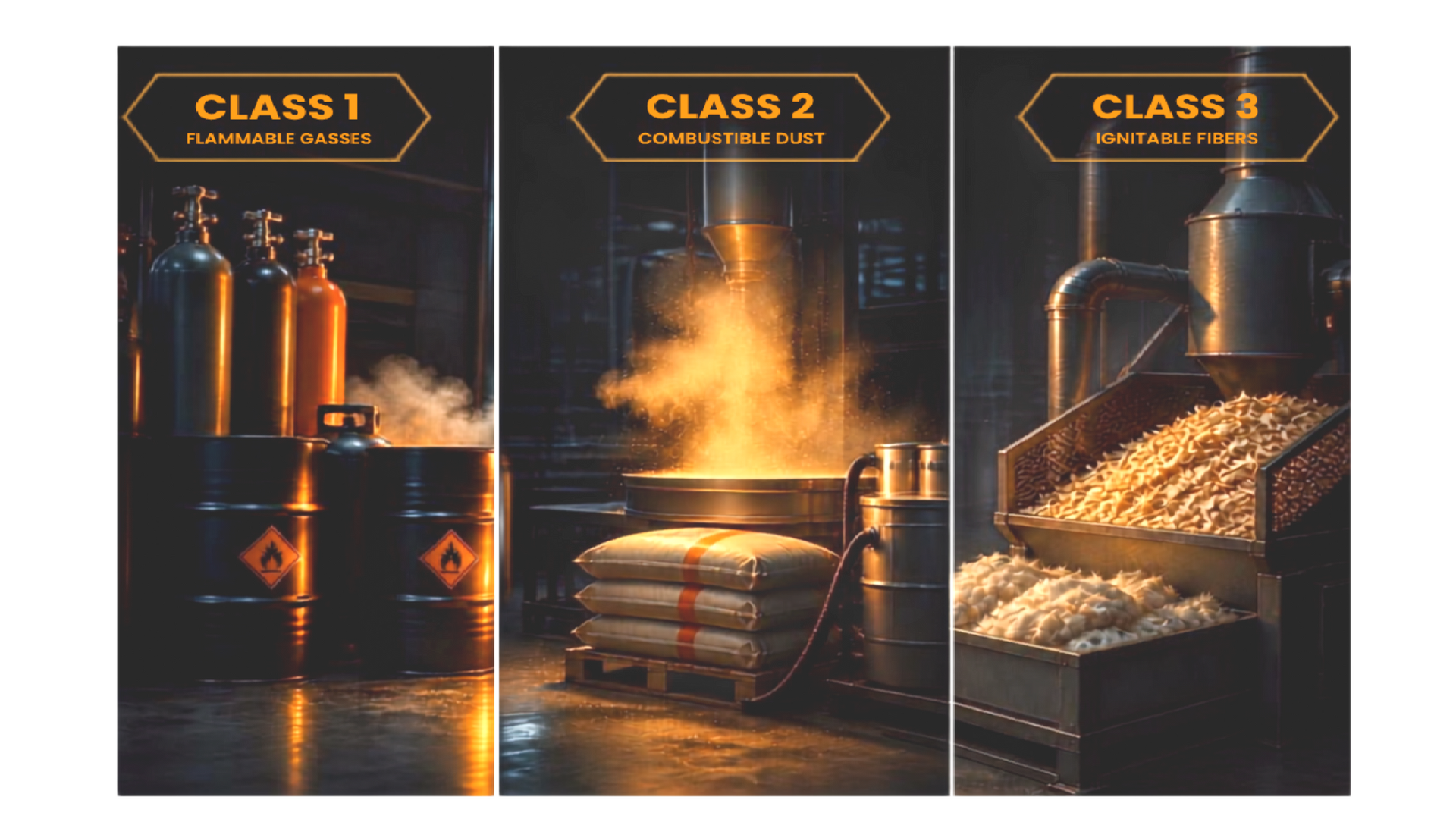
In flour milling operations, high-speed discharge is the most critical performance metric for maintaining profitability. elevator bucket venting for fine materials helps mitigate the risk of dust explosions by minimizing air turbulence inside the elevator casing. This is a vital component of compliance with the 2025 edition of NFPA 660, which consolidated standards for combustible dust safety. We ensure our elevator buckets meet all necessary FDA standards for food handling. This ensures that your facility remains both safe and compliant while maximizing the throughput of your grain processing lines.
The Impact of Vented Buckets on Elevator Belt Longevity and Power Consumption
We observe that inconsistent bucket filling is a leading cause of mechanical vibration and motor surging. When air pillows prevent buckets from filling uniformly, the weight distribution along the belt fluctuates wildly during each revolution. This forces your drive system to work harder to compensate for these "slugs" of material, leading to erratic amperage spikes. By implementing elevator bucket venting for fine materials , we ensure a consistent material density that stabilizes the power draw on your motor.
Uniform bucket filling is critical for protecting your heavy-duty conveyor belting from eccentric loading. When buckets are only partially filled on one side due to trapped air, the resulting imbalance creates a twisting force on the belt. Over time, this leads to tracking issues and uneven edge wear that compromises the belt's structural integrity. Proper venting allows the material to settle evenly across the entire width of the bucket, maintaining perfect belt alignment throughout the lift.
We also analyze how venting reduces air resistance in the boot section. High-speed buckets act like fan blades, creating significant air turbulence that the drive system must overcome through increased torque. Vented designs allow air to pass through the bucket during the dig phase, lowering the torque required for the initial lift. This reduction in resistance also minimizes "blow-back" dust, which acts as an abrasive that prematurely wears out your belt covers and pulleys.
Reducing Belt Stress and Stretch
Consistent loading is the best way to prevent the belt from tracking off-center and stretching unevenly. We evaluate the relationship between bucket weight and total belt tension, typically measured in PIW / kN/m (pounds per inch of width / kilonewtons per meter). Vented buckets permit higher fill rates without the unpredictable weight spikes associated with air entrapment. In our experience, improved discharge through venting significantly reduces "back-legging" stress, which is the primary cause of premature belt failure in high-capacity elevators.
Energy Efficiency Gains in High-Capacity Legs
Reducing air friction and optimizing discharge leads to measurable energy savings in high-capacity legs. We utilize high-efficiency electric motors to maintain a constant speed under varying loads, but reducing the mechanical load itself remains the priority. Because we are independent distributors, we source the exact combination of belt, bucket, and motor to maximize your system's efficiency without brand bias. To optimize your specific lifting requirements, we suggest you contact our engineering team for a full system evaluation.
Strategic Sourcing: Why Custom Venting Outperforms Standard Buckets
We've found that off-the-shelf components frequently fall short when dealing with high-speed centrifugal discharge systems. While standard buckets might suffice for granular grains, they rarely provide the aeration required for elevator bucket venting for fine materials . Because we operate as an independent distributor, we aren't restricted by brand-specific agreements. This freedom allows us to source the specific material-whether it's Polyethylene, Nylon, Urethane, or Steel-that best resists the abrasive or chemical nature of your specific commodity.
Our business model supports mid-market operations that require engineered solutions without the burden of high account minimums. We provide the same level of technical expertise to a single facility upgrade as we do for global plant expansions. This accessibility ensures that your operation can implement precision venting patterns without being forced into bulk purchases that don't align with your maintenance budget. We focus on delivering the exact performance you need, rather than what a manufacturer's stock inventory dictates.
Our logistics network spans six continents, ensuring that custom-vented components reach your facility regardless of geographic location. We manage the entire supply chain to eliminate the delays often associated with distributors who are constrained by regional territories. This global reach is backed by 75 years of export expertise, providing a reliable pipeline for critical MRO parts. We ensure that your elevator bucket venting for fine materials project stays on schedule, from the initial engineering phase to final delivery.
The Jealco International, Inc. Consultative Advantage
We don't just sell parts; we provide engineered solutions based on a thorough analysis of your operational data. Our process begins with an evaluation of your material density, particle size, belt speed, and required capacity. In our experience, matching hole diameter to the specific particle micron size is the only way to prevent vent blinding and maintain airflow. We invite you to contact our engineering team to schedule a system audit and identify your current bottlenecks.
Streamlining International Procurement
Managing large-scale bucket replacements requires more than just hardware; it requires precise logistical coordination. We handle all export documentation and international shipping requirements to ensure your parts clear customs without incident. This expertise is essential for minimizing downtime during scheduled maintenance shutdowns. You can explore our online catalog to review full specifications for our range of buckets and venting options. We remain committed to your long-term operational success through every stage of the procurement cycle.
Achieving Peak Throughput in Fine Material Handling
Venting is not just an optional modification; it's a precision engineering requirement for any facility moving powders. We have demonstrated how proper elevator bucket venting for fine materials eliminates the air pillow effect and prevents vacuum-locking during discharge. These technical adjustments directly translate to a 10% to 20% increase in usable capacity and significantly reduced wear on your heavy-duty conveyor belting. By stabilizing the material flow, you also protect your motors from the amperage spikes caused by uneven loading.
Our independent distribution model provides the technical flexibility to source the exact materials and venting patterns your specific commodity requires. We leverage our 75 years of industrial expertise and global logistics across six continents to deliver these engineered solutions without account minimums. Whether your facility operates on Imperial or Metric standards, we provide the dual-measurement accuracy your procurement team needs for seamless international MRO sourcing.
We're ready to help you optimize your next maintenance cycle. Please contact our technical team for custom venting specifications to ensure your elevator buckets perform at their theoretical maximum. We look forward to supporting your operational success.
Frequently Asked Questions
Does venting reduce the structural strength of the elevator bucket?
Venting reduces the surface area of the bucket, but it doesn't compromise integrity if you follow industry standards. We ensure holes remain at least 1.5 times their diameter apart to maintain structural rigidity. In our experience, high-quality polyethylene or steel buckets handle these modifications without failure under standard loads. We analyze your specific capacity needs to ensure the venting pattern doesn't exceed the safe stress limits of the material.
What is the most common venting pattern for flour and fine grains?
For flour and fine grains, Pattern #1 or Pattern #2 are the most frequent choices. Pattern #1 places holes in the bottom, which is effective for standard centrifugal discharge speeds. If your elevator runs at higher velocities, Pattern #2 adds side-wall venting to assist with more rapid air evacuation. These configurations are essential for achieving the 90% fill rate required for high-volume agricultural processing.
Can I vent existing elevator buckets myself or should I buy them pre-punched?
We always recommend purchasing pre-punched buckets rather than attempting field modifications. Precision drilling ensures that holes are uniform and free of burrs that can trap material. Our independent sourcing model allows us to provide custom-punched buckets tailored to your exact specifications. This professional finish is critical for maintaining the sanitary standards required in food-grade applications. We leverage our 75 years of expertise to ensure every bucket meets industrial tolerances.
How do I determine the correct hole size for my specific material density?
Selecting the correct hole size depends primarily on the particle micron size of your material. Standard diameters range from 1/8 in / 3.17 mm for very fine powders to 3/8 in / 9.52 mm for coarser products. We match the hole size to your material density to ensure air escapes without allowing the product to bridge or leak. Our technical team uses these metrics to optimize elevator bucket venting for fine materials across diverse industrial sectors.
Will fine materials leak through the vent holes during the vertical lift?
Material leakage is rarely an issue because centrifugal force holds the product against the bucket walls during the lift. The internal cohesion of fine powders also prevents them from flowing through small 1/8 in / 3.17 mm vent holes while in transit. We only see leakage if the hole diameter is significantly oversized for the particle micron rating. Proper engineering ensures that the air escapes while the product stays securely in the bucket.
How does bucket venting help in reducing dust explosions in grain elevators?
Venting reduces the risk of dust explosions by minimizing air turbulence and internal pressure within the elevator casing. By allowing air to bypass the bucket during the dig and discharge phases, you reduce the concentration of airborne dust. This is a critical component of complying with the 2025 edition of NFPA 660. Our expertise in elevator bucket venting for fine materials helps facilities maintain a safer work environment through better pressure management.
What is the difference between Pattern #1 and Pattern #5 venting?
The primary difference lies in the intensity and location of the air evacuation holes. Pattern #1 is the most basic configuration, featuring a single row of holes in the bucket bottom for moderate speeds. Pattern #5 is our most aggressive configuration, utilizing multiple rows on both the bottom and side walls. We specify Pattern #5 for dense, cohesive minerals that require maximum aeration to settle and discharge correctly.
Does venting affect the discharge trajectory of the material at the head pulley?
Venting improves the discharge trajectory by breaking the vacuum that forms at the bottom of the bucket. Without vent holes, suction can hold material inside the bucket longer than intended, leading to "back-legging" or carryover. A clean release at the head pulley ensures that the material lands precisely in the discharge chute. This prevents unnecessary abrasive wear on your pulleys and belt covers while maintaining consistent throughput.
Recent Posts