

Industrial Speed Reducer Supplier: Selection and Sourcing Guide

September 24, 2026
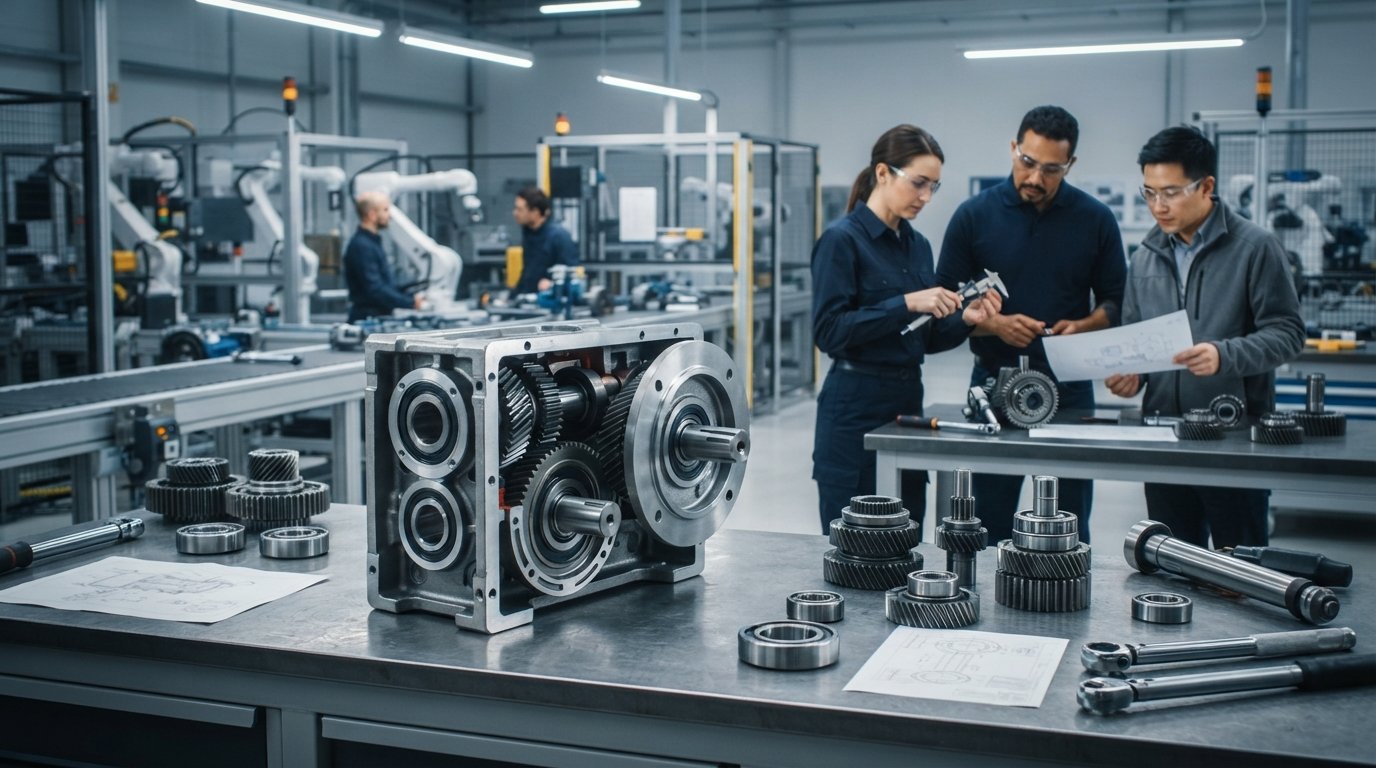
Three technicians review a drawing beside an open helical speed reducer, loose gears and bearings on a steel workbench

A failed gear drive stops the line it powers, and a discontinued model can turn a routine replacement into weeks of downtime. The fix starts with accurate specifications and a supplier who can source across manufacturers.

We'll provide the technical framework you need to evaluate suppliers, calculate essential gearing metrics, and streamline the procurement of complex power transmission components. You'll learn how to navigate AGMA and ISO standards and implement strategies for consolidating multiple brands into a unified supply chain. This guide draws on the 75 years of export expertise at Jealco International, Inc. to help you maintain operational continuity across international borders while ensuring full technical compatibility with your existing motor frames.

Key Takeaways


  • Understand the critical distinction between mechanical and thermal horsepower ratings to prevent premature failure during continuous industrial operation.
  • Learn how a specialized supplier utilizes cross-referencing to find modern replacements for discontinued or legacy gearboxes.
  • Discover the advantages of independent sourcing, which prioritizes technical compatibility across thousands of brands over single-catalog limitations.
  • Master the complexities of international logistics by leveraging established frameworks for customs documentation and export regulations across global markets.
  • Identify the specific nameplate data and operational metrics required to secure accurate quotes and ensure seamless mechanical integration.

Understanding the Role of an Industrial Speed Reducer Distributor

An industrial supplier acts as a technical intermediary, ensuring that the mechanical specifications of a replacement unit align perfectly with the existing prime mover and driven load. Unlike a transactional vendor, a specialized supplier evaluates service factors, thermal ratings, and mounting configurations to prevent the catastrophic failure of power transmission systems. This role is especially critical when handling discontinued equipment, where finding a drop-in replacement requires deep cross-referencing knowledge across thousands of brands. By providing this specialized oversight, a supplier helps facility managers avoid the high costs of unplanned downtime and mechanical mismatch.

The Function of Speed Reducers in Power Transmission

Speed reducers are the backbone of industrial motion. They utilize Gear train principles to convert high-speed, low-torque input from an electric motor into the high-torque, low-speed output required by heavy machinery like conveyors, mixers, and bucket elevators. This mechanical interface must account for axial and radial loads that could otherwise damage the motor shaft. Durability often depends on housing selection. While aluminum offers weight advantages for light-duty tasks, cast iron remains the standard for heavy-duty applications due to its superior vibration dampening and structural rigidity. Selecting the wrong housing material can lead to housing deflection under load, causing gear misalignment and premature wear.

Distributor vs. Manufacturer: Sourcing Strategies

Procurement teams often face a choice between manufacturer-direct sourcing and independent distribution. A manufacturer is inherently limited by their own product lines and catalog. If a specific gear ratio or frame size is out of stock or discontinued, the manufacturer cannot offer an alternative. In contrast, an independent distributor like Jealco International, Inc. provides the flexibility to source across thousands of manufacturers. This independence allows for consultative sourcing, where the focus remains on the technical requirement of the machine rather than the sales targets of a single brand.

For mid-market operations, this means access to legacy parts and modern equivalents that a single-brand portal would simply reject. As an independent distributor since 1950, we've found that this flexibility is vital for maintaining older systems where the original OEM may no longer provide support. You can explore our range of gearing products to see how varied brands can be integrated into a single procurement path. This approach doesn't just simplify logistics; it ensures the chosen component is the best technical fit for the specific application environment.

Engineering Metrics for Gearbox Selection and Sizing

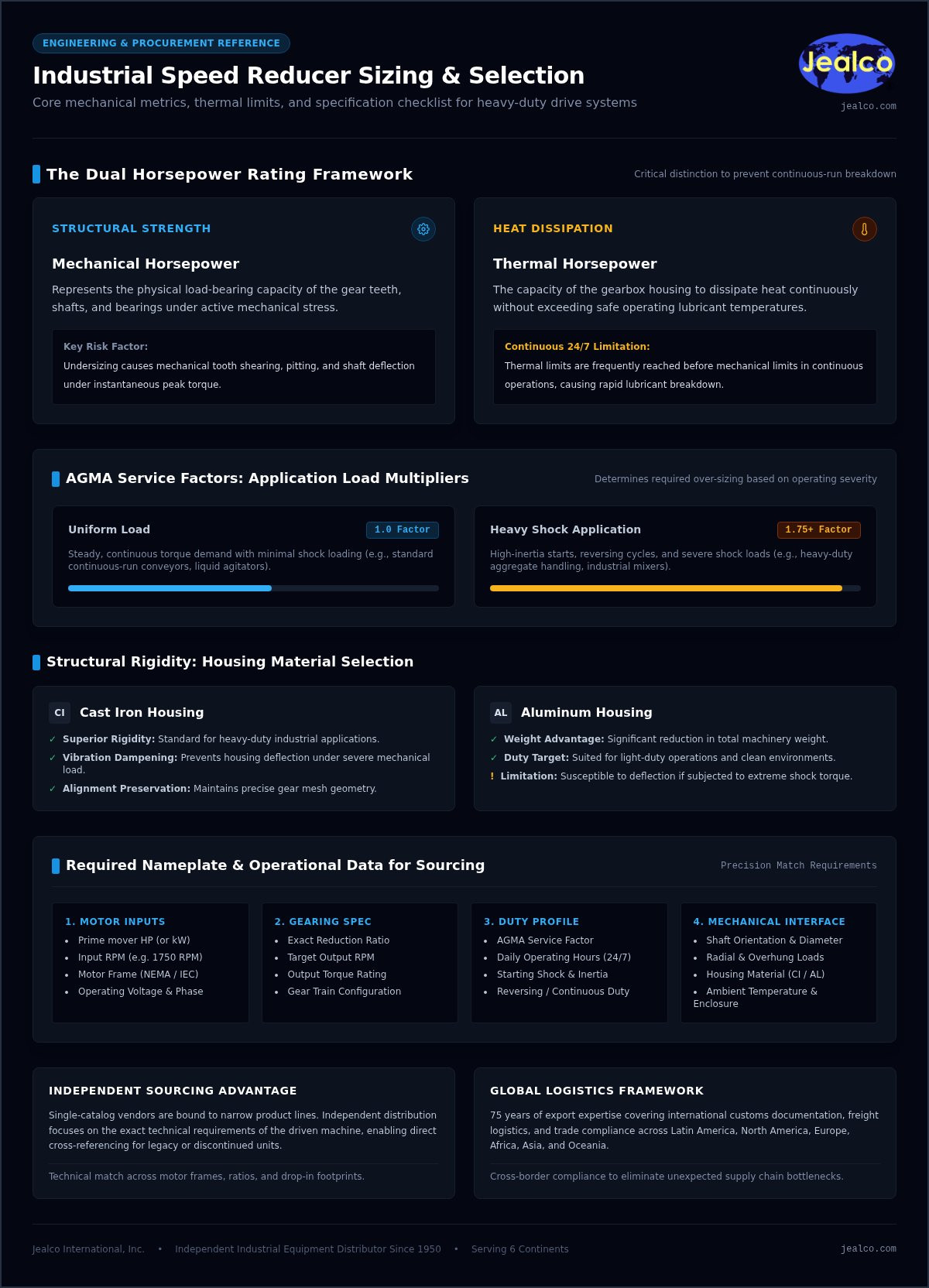
Selecting a speed reducer requires more than matching a motor's horsepower to a gearbox's input rating. An experienced supplier will distinguish between mechanical and thermal horsepower. Mechanical horsepower represents the physical strength of the gear teeth and shafts under load. Thermal horsepower is the capacity of the unit to dissipate heat during continuous operation without exceeding safe oil temperatures. If the application runs 24/7 in a high-ambient environment, the thermal limit is often reached long before the mechanical limit, potentially leading to lubricant breakdown and catastrophic failure.

AGMA Service Factors and Application Load

Applying the correct AGMA service factor is the most critical step in sizing. This multiplier accounts for the specific stresses of the application, such as shock loads in heavy-duty conveyor systems or high-inertia starts. For example, a uniform load might require a 1.0 factor, while a heavy shock application could demand a factor of 1.75 or higher. Undersizing a unit by ignoring these factors leads to excessive heat generation and pitting of the gear teeth. If you're unsure about the specific multiplier for your equipment, you can consult our technical team for a sizing review.

Thermal Ratings and Environmental Considerations

Environmental conditions directly impact the gearbox's ability to shed heat. In outdoor or poorly ventilated installations, the choice of motor enclosure, such as TEFC (Totally Enclosed Fan Cooled) versus ODP (Open Drip Proof), affects the airflow around the reducer. Lubrication requirements also shift based on mounting positions. A vertical mount might require different oil levels or specialized seals compared to a standard horizontal setup to ensure the top bearings receive adequate splash lubrication.

Gear efficiency varies significantly by design. Helical gearboxes typically achieve efficiencies of 95% or higher, whereas worm gearboxes may range between 60% and 80% due to sliding friction. These efficiency losses manifest as heat, further stressing the thermal capacity of the unit. Additionally, engineers must calculate the overhung load, which is the force applied perpendicular to the shaft. Excessive overhung load reduces the L10 bearing life, often causing shaft deflection. When sourcing equipment globally, a reliable industrial distributor ensures that the selected unit meets both local operational needs and international compliance frameworks, including Export requirements and harmonized AGMA/ISO standards.

The Independent Distributor Advantage in Procurement

Strategic procurement in power transmission requires a shift from transactional purchasing to consultative sourcing. While automated portals offer speed, they often lack the technical nuance required to verify that a selected unit will actually fit the existing infrastructure. An independent distributor provides the flexibility to evaluate components across manufacturers, ensuring the choice is dictated by mechanical requirements rather than catalog availability. This approach allows for the consolidation of critical components, such as motors, reducers, and couplings, into a single, verified procurement path. By treating the drive assembly as a complete system, we reduce the compatibility risks that arise when sourcing parts from multiple, disconnected vendors.

Cross-Referencing Legacy Gearing

Replacing discontinued units is a common challenge for aging facilities. To ensure a modern equivalent performs correctly, we identify key data from the nameplate, including the manufacturer, model, and specific serial number. Matching mounting dimensions is vital, particularly when navigating the differences between NEMA (imperial) and IEC (metric) frame standards. Beyond the base mounting, we verify shaft diameters and keyway compatibility to ensure that the new unit interfaces correctly with existing gearing products without requiring costly on-site modifications. This meticulous cross-referencing process prevents the installation delays that occur when a replacement unit arrives with a mismatched output shaft or foot pattern.

Strategic Sourcing for Complex Systems

Complex systems often utilize a mix of brands that have been integrated over decades. A dedicated supplier manages these mixed-brand requests through a human technical review process, which acts as a safeguard against ordering errors. This personalized service replaces the 'best-guess' approach of automated portals, where a single incorrect character in a part number can lead to weeks of downtime. By centralizing the sourcing of thousands of brands, businesses can significantly reduce the number of vendors in their supply chain, simplifying both accounting and logistics. Jealco International, Inc. has refined this consultative model since 1950, acting as a strategic partner that prioritizes long-term operational success and technical accuracy over a simple sale.

The ability to source across manufacturers also provides a critical buffer against OEM lead times. When one manufacturer faces production delays, an independent distributor can often identify a technically equivalent unit from another brand that meets the same AGMA or ISO performance standards. This flexibility isn't just a convenience; it's a risk-mitigation strategy that keeps production lines moving when supply chains tighten. Our technical team focuses on finding the right part for the application, whether that means a standard helical unit or a specialized planetary reducer designed for high power density.

mechanical vs thermal horsepower, AGMA service factors 1.0 to 1.75+, housing materials and data needed to quote

International Logistics and Export Requirements for Gearing

Exporting heavy mechanical components requires a sophisticated understanding of both physical protection and regulatory compliance. Industrial gearboxes are precision instruments that happen to be extremely heavy, often weighing several hundred pounds (100 kg or more), which necessitates specialized handling. Since 1950, Jealco International, Inc. has managed the complexities of shipping to customers across six continents, including North America, Latin America, Europe, Africa, Asia, and Oceania. This global reach is built on a foundation of robust packaging protocols, such as using vapor corrosion inhibitors (VCI) and reinforced crating, to ensure that precision-ground gear teeth remain free from environmental degradation during long sea transits.

Global Sourcing and Supply Chain Resilience

Operations located outside of North America must account for longer lead times and varied technical standards. A competent distributor checks sourced equipment against the requirements of the destination country, whether that involves ISO (International Organization for Standardization) load ratings or IEC (International Electrotechnical Commission) motor mounting dimensions. For facilities operating in hazardous environments, we source units certified under the ATEX Directive 2014/34/EU for European markets or the IECEx system for global applications. Managing these international shipping schedules requires proactive planning to synchronize with local maintenance windows and minimize the risk of production stoppages.

Documentation and Customs Expertise

Customs clearance is often the most significant bottleneck in international procurement. Delays frequently arise from the incorrect application of Harmonized System (HS) codes, which dictate duty rates and regulatory oversight. Speed reducers generally fall under HS code 8483.40, but specific technical characteristics can alter the sub-classification. As an experienced international supplier, we facilitate the preparation of accurate commercial invoices, certificates of origin, and export licenses governed by the Export Administration Regulations (EAR). Providing precise documentation reduces the risk of port storage fees and ensures that critical replacement parts reach the facility without administrative friction.

Successful international delivery depends on the distributor's ability to act as a logistics partner rather than just a vendor. We coordinate with freight forwarders to select the most efficient transit routes, balancing the urgency of the replacement with the weight constraints of the machinery. This logistical oversight extends to the final mile, ensuring that the heavy-duty components are delivered to the site with the necessary equipment for safe unloading. If your operation requires support for a complex international shipment, contact our export logistics team to discuss a tailored procurement plan.

Data Requirements for Speed Reducer Quotes

Accurate procurement begins with the precise collection of technical data. When you engage an industrial supplier , the quality of the information provided directly determines the reliability of the resulting proposal. Technical teams shouldn't rely on memory or incomplete maintenance logs; instead, they must extract data directly from the equipment nameplate. This nameplate serves as the primary record of the unit's DNA, including the manufacturer, model number, and serial number. These identifiers allow a distributor to access original factory specifications and design tolerances that aren't always visible to the naked eye.

Operational metrics form the next layer of a complete quote request. You must specify the input RPM, which is typically governed by the motor speed, and the required output RPM or the specific gear ratio. While horsepower is a standard metric, calculating the required torque at the output shaft is often more critical for heavy-start applications. Additionally, the physical configuration must be clearly defined. This includes the shaft orientation, such as parallel or right angle, and the specific mounting requirements, whether the unit is foot-mounted, flange-mounted, or shaft-mounted.

What to Send Us for a Quote

A clear, high-resolution photograph of the nameplate is the most effective tool for an industrial speed reducer supplier to identify legacy or discontinued units. Beyond the photo, you should provide precise measurements for input and output shaft diameters and lengths. Identifying the mounting bolt patterns and bore sizes is also essential for ensuring a drop-in fit. If the environment involves high humidity, extreme temperatures, or abrasive dust, these application details must be included to ensure the seals and lubrication are specified correctly for the duty cycle.

Evaluating the Final Proposal

Once you receive a proposal, the technical review should focus on the balance between mechanical and thermal ratings. As discussed earlier, the unit's ability to dissipate heat is just as vital as its structural strength. You must also verify the mechanical compatibility with your existing electric motors, ensuring the NEMA or IEC frame sizes align perfectly. A proposal that only matches the ratio but ignores the overhung load capacity or thermal limits poses a risk to long-term facility uptime.

The transition from identifying a need to receiving a verified component requires a meticulous attention to detail. By providing comprehensive data upfront, you allow our technical team to cross-reference thousands of brands and identify the most robust solution for your specific load requirements. This precision reduces the likelihood of installation delays and ensures the new reducer integrates seamlessly into your power transmission system. To begin this process, you can Contact Jealco for technical sourcing assistance and provide your equipment specifications for a professional review.

Optimizing Power Transmission Through Specialized Sourcing

Selecting the correct gearing requires a precise balance between mechanical strength and thermal endurance. A successful procurement strategy relies on verifying nameplate data and understanding how environmental factors influence duty cycles. Jealco International, an independent distributor since 1950, provides the technical oversight necessary to navigate these complexities. We bridge the gap between rigid manufacturer catalogs and your specific facility requirements.

By choosing an experienced distributor, you gain access to thousands of industrial brands and 75 years of global export expertise. This ensures that even the most complex mixed-brand systems remain operational through accurate cross-referencing and robust international logistics. Our team focuses on finding the best technical fit to minimize downtime and consolidate your procurement path. It's a strategic approach that prioritizes functionality over simple transactions.

If you're ready to secure a compatible replacement for your power transmission system, you can Request a Technical Quote for Industrial Speed Reducers. We're committed to supporting your operational success with precision-sourced components and specialized technical assistance.

Frequently Asked Questions

What is the difference between a speed reducer and a gearbox?

Technically, all speed reducers are gearboxes, but not all gearboxes are speed reducers. A speed reducer specifically functions to decrease input speed while simultaneously increasing torque. A gearbox is a broader category for any gear-based transmission, including those that increase speed or maintain a one-to-one ratio. In industrial settings, these terms are often used interchangeably to describe the units that interface between motors and driven loads.

How do I determine the ratio of my existing speed reducer?

The gear ratio is typically listed on the manufacturer nameplate as a fixed value. If the nameplate is missing or illegible, you can calculate it by dividing the input RPM, which is the motor speed, by the measured output RPM of the reducer. Another method involves counting the number of turns on the input shaft required to complete one full rotation of the output shaft. A technical supplier can verify this through internal gear tooth counts.

Can a speed reducer be mounted in any orientation?

No, the mounting orientation must be specified at the time of purchase to ensure proper lubrication and venting. A unit designed for horizontal mounting may suffer from dry bearings if installed vertically because the oil splash pattern won't reach the upper components. Specialized seals and specific oil levels are required for non-standard positions. Always verify the internal oil passages and breather locations before changing the installation angle from the original factory setting.

What information is required to cross-reference a discontinued gearbox?

You need the original manufacturer name, the model number, and the serial number. Beyond these identifiers, physical measurements are vital for a successful cross-reference. This includes the input and output shaft diameters, the shaft length, and the specific footprint of the mounting bolts. Providing a high-resolution photograph of the nameplate to your distributor is the most reliable way to identify legacy units and find a compatible modern equivalent.

How does the AGMA service factor affect gearbox longevity?

The AGMA service factor acts as a safety margin that accounts for application-specific stresses. Selecting a unit with a factor of 1.4 instead of 1.0 significantly increases the design life by allowing the gears to handle shock loads and intermittent overloads without fatigue. Failure to apply the correct service factor leads to accelerated tooth wear and bearing failure; this shortens operating life, especially in demanding environments.

What are the most common causes of industrial speed reducer failure?

Lubrication issues, such as contamination or insufficient oil levels, remain the leading cause of gearbox failure. Overheating due to exceeding thermal ratings or poor ventilation also causes oil to break down, leading to gear pitting. Other common factors include shaft misalignment, which creates excessive radial loads on the bearings, and selecting a unit that doesn't account for the shock loads inherent in the specific material handling application.

Does Jealco provide international shipping for heavy industrial components?

Jealco International specializes in global logistics for heavy machinery and has exported to six continents since 1950. Our team manages the customs documentation and international shipping requirements for units weighing often weighing several hundred pounds (100 kg or more). We utilize specialized packaging and vapor corrosion inhibitors to protect precision components during sea or air transit. This expertise ensures that heavy-duty gearboxes arrive at international facilities without administrative delays or environmental damage.

How do thermal ratings limit the performance of a speed reducer?

Thermal ratings define the maximum power a reducer can transmit continuously without the lubricant exceeding safe temperature limits. Even if a gearbox is mechanically strong enough to handle the torque, it may fail if it can't dissipate the heat generated by friction. In high-ambient environments, the thermal limit is often lower than the mechanical rating. This requires the use of external cooling systems or selecting a larger unit with more surface area.

Share this article

Recent Posts

By Mark Lacefield • September 17, 2026
Why "we apologize for any inconvenience" minimizes real customer problems, where the word came from, and what to say instead to build trust with industrial clients.

Two engineers with a tablet beside an inclined conveyor carrying crushed aggregate
By Jealco International • September 14, 2026
Calculate belt conveyor horsepower with CEMA 7th Edition formulas — effective tension, drive efficiency, and a worked 7.5 HP example from Jealco International.

photo depicting various hazardous classes such as  flammable gas, dust, or ignitable fibers
By Jealco International, Inc. • September 1, 2026
In a 2026 survey, 79% of supply chain managers identified cost as their primary disruption, but cutting corners on equipment for hazardous locations is never a viable strategy. We understand the pressure you face when balancing high compliance costs against the fear of a catastrophic site failure. I…,Don't compromise on safety. We help you choose the right industrial motors for hazardous locations by clarifying complex Class/Division and Zone standards.
image of speed reducer gears in an enclosed container showing worn versus well-maintained gears
By Jealco International, Inc. • August 24, 2026
Did you know that inadequate lubrication is the primary cause of industrial gear failure, accounting for 34.4% of all documented incidents? We've seen how a single oversight in speed reducer lubrication best practices can lead to catastrophic downtime and expensive repairs. While many operators focu…,Avoid gearbox failure with our speed reducer lubrication best practices. We simplify lubricant selection and monitoring to extend equipment life and cut main...

Gloved hand holding a non-sparking beryllium copper wrench over assorted wrenches and socket bits on a dark workbench
By Jealco International, Inc. • August 17, 2026
The global market for specialized safety tools is projected to reach $2.40 billion by 2034, highlighting a massive increase in demand for precision-engineered equipment. We know that for engineers in MRI suites or explosive aerospace environments, a single ferrous mistake can lead to catastrophic eq…,Avoid catastrophic failure with the right non-magnetic hand tools. Our guide helps you compare alloys, prevent contamination, and streamline global sourcing.

Three white elevator buckets stacked with flour against a dark rustic background
By Jealco International, Inc. • August 10, 2026
Your bucket elevator might be running at high speed, but if you are moving powders, you are likely transporting more air than product. We frequently see facilities struggling with a 60% fill rate because trapped air creates a "pillow" that rejects incoming material. This air displacement doesn't jus…,Boost throughput by 20% with proper elevator bucket venting for fine materials. We show you how to eliminate air pillows, reduce dust, and meet NFPA 660 stan...

technicians evaluating a piece of equipment in a grain processing facility
By Jealco International, Inc. • August 3, 2026
A single mechanical spark in a volatile atmosphere isn't just a safety violation; it's a potential catalyst for a catastrophic industrial explosion. You understand that protecting your facility requires more than just a generic safety plan. It demands a rigorous technical approach to every non-spark…,Learn to select non-sparking conveyor components by alloy type, meet OSHA & ATEX standards, and source certified MRO parts globally with Jealco.

Person at computer reviewing cost estimates for a conveyor system
By Jealco International, Inc. • July 27, 2026
With US average effective tariff rates hitting 11.0% in 2026, your initial equipment quote is no longer a reliable reflection of your final investment. You understand that a conveyor system is your facility's backbone. However, you're likely tired of "sticker shock" from hidden export fees and propr…

Stainless steel sanitary conveyor with open-frame design and washdown-rated motor for food processing environments.
By Jealco International, Inc. • July 20, 2026
Learn the engineering principles for sanitary conveyor design for food processing. We'll show you how to meet FSMA rules and cut cleaning time by 30% or more.
Industrial roller chain and sprocket drive on a conveyor system, illustrating proper tension for maximum service life.
By Jealco International, Inc. • July 13, 2026
Master how to properly tension a roller chain using the 2% slack rule, precision alignment steps, and detailed failure diagnostics to maximize drive service life.
Show More