Conveyor Belt Slipping: Common Causes and Professional Solutions for 2026

A slipping belt can stop a production line without warning, and an hour of lost output in a high-volume plant is expensive. We know that conveyor belt slipping causes and solutions are the difference between profit and waste. It's one of the most common problems in high-volume food processing.
You likely feel the pressure of rising energy costs and tight delivery windows. It's frustrating to see a belt wear out after only 8 months of service. We believe your industrial equipment should be a source of certainty, not a safety risk. Unplanned downtime shouldn't be part of your weekly routine.
We'll help you identify the root causes of slippage and apply permanent fixes. You'll learn how to set up a 2026 maintenance schedule that works. This guide provides the technical steps to adjust a 10-foot (3-meter) section or an entire line. Let's ensure your facility runs at peak efficiency starting today.
Key Takeaways
- Understand how belt slippage impacts your bottom line and operational costs.
- Identify the primary conveyor belt slipping causes and solutions for 2026.
- Learn the exact steps we use to restore pulley grip immediately.
- Discover why proactive monthly inspections prevent expensive reactive repairs.
- See how our technical expertise keeps your production moving efficiently.
Understanding Conveyor Belt Slipping and the True Cost of Downtime
Conveyor belt slippage is a critical mechanical failure. It stops production cold. It happens when the drive pulley rotates faster than the belt. This loss of grip comes from a drop in friction. When looking for conveyor belt slipping causes and solutions , focus on traction. Traction is the heart of your system. Without it, the pulley spins against the belt. This creates a destructive grinding effect.
The immediate result of slippage is intense heat. Friction generates thermal energy very quickly. Temperatures often exceed 150°F (65.5°C). This heat destroys the belt carcass and covers. It causes the rubber to glaze or harden. This glazing further reduces traction. It becomes a dangerous cycle. In some cases, this heat even starts fires. This is common in grain elevators or bakeries.
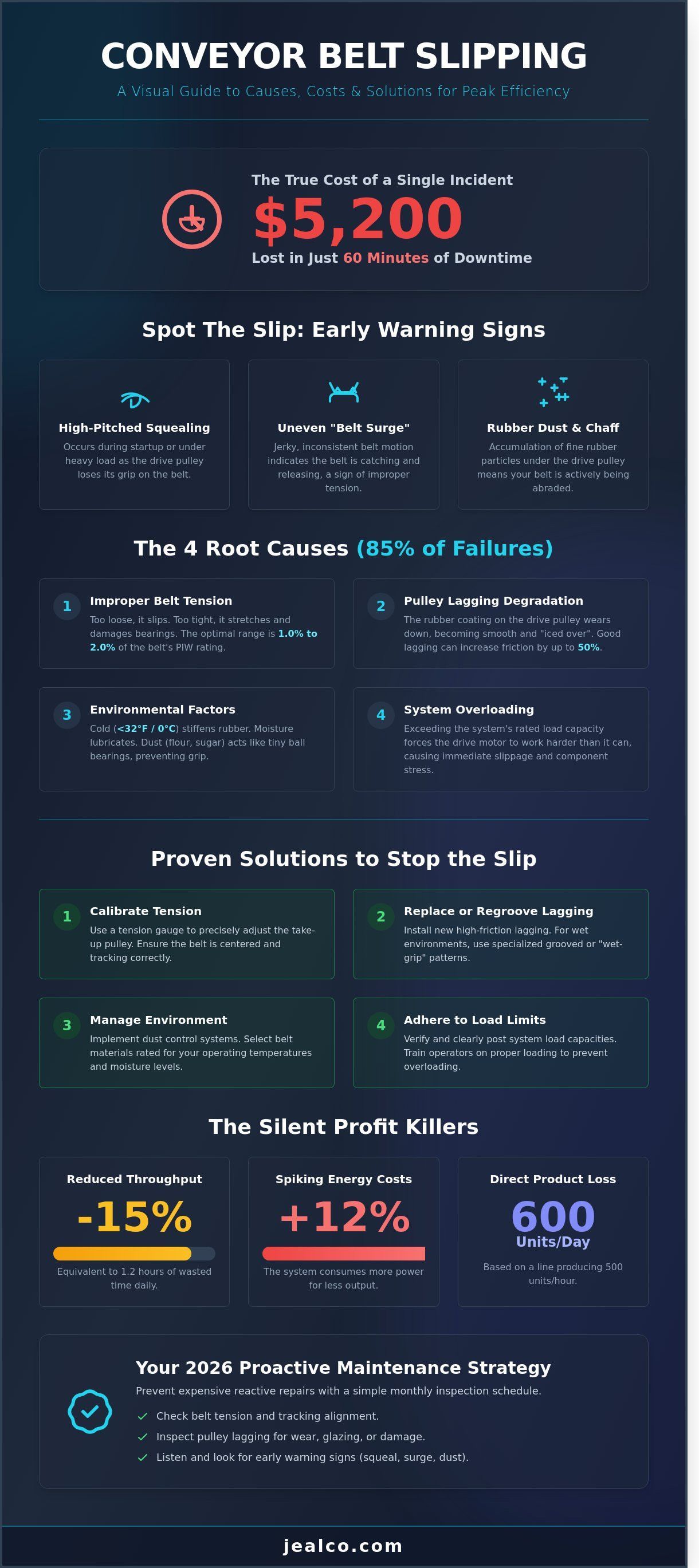
Downtime is expensive for any facility. A slipping belt reduces throughput. On a busy line, that adds up to real lost time every day. If you produce 500 units per hour, you lose 600 units. This isn't just a minor glitch. It's a direct hit to your bottom line. These losses compound over weeks of operation.
The Silent Profit Killer: Why We Care About Traction
Friction moves your product from point A to point B. When traction fails, you waste energy. Your system consumes more power for less output. This leads to much higher electricity bills. Slip also raises energy costs. We recommend checking your belt conveyors for speed variances weekly. A simple tachometer reading saves thousands in utility costs. You can find a Conveyor belt overview to learn about standard drive setups. Maintaining friction ensures every watt of power moves product.
Early Warning Signs of a Slipping System
You don't need advanced sensors to spot slippage. Listen for high-pitched squealing sounds. These noises happen during startup or under heavy loads. If you hear this, the pulley is losing grip. Watch for "belt surge" where the belt moves in jerks. This uneven motion means the belt catches and slips. It's a sign of inconsistent tension. Finally, inspect the area under your drive pulleys. Look for rubber dust or "chaff" accumulating. This debris means your belt is being sanded down. Address these signs early to avoid total system failure. Quick action prevents costly emergency repairs.
The Root Causes of Conveyor Belt Slippage
Slipping stops your production line. It wastes time and money. Identifying conveyor belt slipping causes and solutions starts at the drive pulley. If the belt lacks grip, the motor spins while the product stays still. This friction creates heat. Heat damages your belt material. Four factors cause most of these failures.
Improper Belt Tension and Tracking
Tension is the number one cause. A loose belt lacks the "wrap" needed for the pulley to grab. It just slides. But do not over-tighten it. Over-tensioning stretches the belt permanently. This ruins the internal fabric. Keep operating tension within the belt manufacturer's PIW (Pounds per Inch of Width) rating. Proper tracking also ensures the belt stays centered. If it wanders, it loses contact with the drive surface. Following CEMA safety best practices helps prevent these mechanical misalignments. We always check the take-up pulley first during inspections.
Pulley Lagging Degradation
Pulley lagging is the rubber coating on the drive pulley. It provides essential friction. Good lagging substantially increases the friction coefficient. Over time, this rubber wears down. It becomes smooth or "iced over." When this happens, metal-to-rubber contact becomes metal-to-metal contact. Metal is slippery. Worn pulleys are often the hidden culprit. If your lagging looks shiny, it needs immediate replacement. You might also consider regrooving for a temporary fix. Smooth lagging cannot move a heavy load of dough or bread trays.
Environmental and Temperature Factors
Your environment changes how your belt behaves. Cold temperatures below 32°F (0°C) are a major issue. They make rubber belts stiff and slick. The belt loses its natural tackiness. Humidity is another factor. In wash-down environments, water acts as a lubricant. You need specialized "wet-grip" lagging for these areas. Dust is also a silent killer. Flour or sugar buildup acts like tiny ball bearings. It sits between the belt and the pulley. This creates a barrier. It prevents any real grip from occurring.
System Overloading and Drive Failure
Do not ignore the load weight. Every system has a rated capacity. If you exceed this, the drive motor cannot move the mass. This leads to immediate slippage. Systems fail when the load exceeds the line's rated capacity. It puts immense stress on the mechanical splices. If you need help sizing your equipment, our technical assistance team can review your current setup. Overloading causes the belt to hesitate. This hesitation creates flat spots on the underside of the belt. Once these spots form, the belt will never run smoothly again. Constant monitoring of your throughput prevents these costly errors.
Proven Solutions to Stop the Slip Immediately
We start every technical intervention by removing grease and flour dust. These contaminants sharply reduce the coefficient of friction. Use a food-grade degreaser. Wipe the pulley faces until they show bare metal or clean lagging. If you skip this step, other adjustments won't last.
Proper tension is the next priority. We adjust the take-up unit to restore slack-side tension. Tension PVC belts to the manufacturer's specified elongation. If the belt sags more than 1 inch (25.4 mm) between rollers, it's too loose. Tighten the screws evenly on both sides to maintain alignment.
Never rely on belt dressing as a permanent fix. We view it as a 24-hour emergency measure only. It creates a sticky residue that attracts abrasive debris. This grit eventually wears down your pulleys. Addressing conveyor belt slipping causes and solutions requires fixing the mechanics, not just adding chemicals.
Motor health often hides behind mechanical symptoms. We check the drive motor for torque consistency during peak loads. Motor torque falls roughly with the square of voltage, so even a small voltage drop costs torque. This power loss causes the belt to stutter under heavy batches of dough.
Mechanical Adjustments for Tension Control
We increase the arc of contact using a snub pulley. This simple addition wraps the belt further around the drive pulley. We aim for an arc of 180 to 210 degrees. Ensure the drive pulley is square to the frame. Even slight misalignment causes tracking issues. Check that gravity take-up weights, often 50 lbs (22.7 kg) or more, move freely in their tracks.
Upgrading Your Drive Components
A failing motor mimics belt slippage during load spikes. We recommend you check your electric motors for phase imbalance or overheating. Even a small voltage unbalance raises motor temperature significantly (see NEMA MG 1). Soft-start gearmotors help here. They reduce startup torque spikes, which protects the belt from sudden jerks.
Surface Treatments and Lagging Solutions
Replace worn rubber lagging with ceramic options for high-tension lines. Ceramic lagging provides far more grip than bare steel. We use diamond-pattern lagging to shed water and flour debris effectively. This pattern acts like a tire tread. Verify the lagging thickness is consistent across the entire pulley face. A variance of 0.125 inches (3.1 mm) can cause the belt to drift and slip.
We focus on durability and operational success. Do you need a professional audit of your conveyor systems? Contact Jealco today to schedule a technical consultation and keep your production line moving.
Designing a Preventative Maintenance Strategy
We believe proactive care is cheaper than reactive repairs. Every single time. Emergency fixes cost far more than scheduled service. When you wait for a breakdown, you lose production hours and pay premium shipping for parts. We help customers move away from this cycle of "firefighting."
We suggest a monthly inspection of all critical drive components. This schedule helps identify conveyor belt slipping causes and solutions before they stop your line. We recommend setting a recurring calendar alert for the first Tuesday of every month. It takes about 45 minutes but saves hours of downtime later.
Training your operators to spot "belt lag" saves thousands in parts. Early detection can save a motor from burning out. If an operator sees the belt stuttering while the drive pulley turns, they must report it. Catching this early prevents heat damage to the pulley lagging and the belt carcass.
You should keep a log of all tension adjustments. We use these logs to track belt stretch over time. If a belt keeps stretching beyond its take-up range, it's nearing the end of its life. Record the date and the number of turns applied to the take-up screws. This data tells us if your conveyor belt slipping causes and solutions are related to age or mechanical failure.
The 10-Point Drive Inspection Checklist
We start every audit by verifying pulley alignment. Use a laser or a simple string line to check for parallelism. Even a 1/16 inch (1.5 mm) deviation causes uneven wear. We then measure the motor amp draw under full load conditions. If the motor pulls more current than its rating, friction is a likely culprit. Finally, we inspect the pulley lagging for bald spots or lifting edges. Worn lagging reduces the coefficient of friction by half.
Selecting the Right Belt for Your Application
Choosing the wrong material is a common mistake. Heavy loads require heavy-duty conveyor belting with high tensile strength. Standard belts fail when the load exceeds their rating. You must also ensure the belt cover is compatible with your product. For example, animal fats in bakeries require oil-resistant nitrile covers. If the belt swells, it won't track or grip correctly.
We always match the belt thickness to your minimum pulley diameter. A belt that is too thick will crack when it wraps around a 4-inch (101 mm) pulley. This internal cracking creates a "stiff" belt that slips more easily. Our team can help you calculate the exact specifications for your specific machinery setup.
Do you need help auditing your current conveyor system for efficiency? Contact our technical team at Jealco today for a professional consultation.
How Jealco Keeps Your Operations Moving
Jealco International, Inc. understands that downtime is your biggest enemy. We supply high-quality industrial components to facilities in over 20 countries. Our expertise spans from basic 150mm (6-inch) drive pulleys to fully integrated automation loops. We focus on technical precision to ensure every part fits perfectly. Our team helps you diagnose conveyor belt slipping causes and solutions to prevent unplanned downtime.
Choosing the wrong component is a common cause of premature system failure. We don't guess; we calculate. We review your load weights and motor speeds. We look at environmental factors like humidity and temperature. This analysis helps your hardware last longer. We provide the high-friction components that address common conveyor belt slipping causes and solutions in wet or oily environments.
We pride ourselves on being a strategic partner for your business. We've served industrial customers since 1950. Our solutions focus on durability and hygiene. You get more than a part; you get our full technical legacy. We measure pulley alignment down to 0.5mm (0.02 inches) to prevent belt wandering.
- We provide global access to premium industrial hardware.
- Contact us for urgent parts needs.
- We customize components to fit your specific machinery.
- The right parts reduce energy consumption.
Premium Belting and Accessories
We maintain a large stock of belting accessories for rapid repairs. Our inventory includes everything from tracking guides to 12mm (0.47-inch) thick impact beds. We provide carcasses made of PVC, polyurethane, and heavy-duty rubber. These materials handle temperatures from -20°C (-4°F) up to 110°C (230°F). Every component meets or exceeds CE and international industrial safety standards. This variety ensures your system handles heavy loads without stretching.
High-Performance Motors and Gearing
Consistent torque is essential for preventing belt slippage. We distribute top-tier motors designed for continuous 24/7 operation. Our gearmotors provide a soft start even when the belt carries a 2,000kg (4,400 lbs) load. This smooth acceleration protects your belt from sudden tension spikes. Our motors feature IP66 protection ratings for harsh washdown environments. We offer technical consultations to help you size your next drive upgrade correctly.
Precision gearing reduces the heat buildup in your drive assembly. We select ratios that match your specific throughput needs. This reduces wear on your lubricants and internal seals. It's a simple way to lower your total cost of ownership. We ensure the motor frame size matches your existing mounts for a 1-hour swap-out time. This speed keeps your production schedules on track during critical shifts.
Our goal is to keep your facility running at peak efficiency. We've supported over 1,200 major industrial projects since our founding in 1998. We provide the parts and the knowledge to solve your toughest mechanical hurdles. Contact our experts today to schedule a full component review. Share this guide with your maintenance team to help them troubleshoot faster. We're ready to help you optimize your next project.
Secure Your Production Efficiency for 2026
Addressing slippage immediately protects your bottom line . A drop in tension causes slip and wastes motor energy. Even a 0.5-inch (12.7 mm) misalignment can trigger a complete system shutdown. Regular weekly inspections of pulley lagging prevent these costly interruptions.
Mastering conveyor belt slipping causes and solutions ensures long-term success. Since 1950, our family-owned team has provided specialized expertise in power transmission. We distribute high-quality components worldwide to keep global food lines moving.
You deserve a partner who understands heavy-duty material handling . We offer technical experience since 1950 to support your facility. Our goal is to eliminate downtime through robust engineering and reliable parts. We don't just sell equipment. We provide lasting reliability for your thermal processes.
We're ready to help you build a more resilient system today.
Frequently Asked Questions
How do I know if my conveyor belt is too loose?
You'll see visible sagging between the return rollers. You might also hear a squealing noise during startup. If the belt center drops more than 2 inches (50.8 mm) below the rollers, it's too loose. This is common in hot processes where heat stretches the material. Check your drive pulley. If it spins while the belt stays still, you've lost tension.
Can I use belt dressing to stop slippage permanently?
No, belt dressing is only a temporary fix. It often attracts flour dust and debris in food production environments. This buildup creates a sticky mess that actually damages your pulley lagging over time. We recommend finding the root cause instead of relying on chemical sprays. A permanent mechanical fix is better.
What is the ideal tension for a standard industrial conveyor belt?
Most industrial PVC belts need a small, specified installation stretch; check the manufacturer's value. You can measure this by marking two points 100 inches (254 cm) apart on a slack belt. Tighten it until the marks move to 100.7 inches (255.8 cm). Correct tension prevents conveyor belt slipping causes and solutions like premature motor failure. Always check your specific manual for exact figures.
Does cold weather really make conveyor belts slip?
Yes, temperatures below 40°F (4.4°C) make the belt material stiff and less grippy. This cold-induced rigidity reduces the friction between the belt and the drive pulley. This is common in refrigerated rooms or unheated warehouses. Let the system run empty for 15 minutes to warm up the components. This helps the material regain its natural flexibility .
How often should I replace my pulley lagging?
Replace your pulley lagging when it's significantly worn or the pattern is gone. In high-volume bakery setups, a full inspection at least once a year is a sensible baseline. Lagging life varies with load, speed and contamination. Worn lagging is one of the primary conveyor belt slipping causes and solutions we address during technical audits. Don't wait for a total failure.
What happens if I over-tighten my conveyor belt?
Over-tightening makes your bearings fail sooner. It puts extreme stress on the drive shaft and can even snap the belt's internal fabric. Pulleys can bend under excessive tension in heavy-duty industrial lines. Always use a tension gauge to keep forces within the manufacturer's specified limits. Protecting your hardware saves money long-term.
Why does my belt only slip when it is fully loaded?
This happens because the weight increases the resistance the motor must overcome. If your friction coefficient is low, the drive pulley can't grab the belt under a 100 lb (45.3 kg) load. We find that worn-out pulley lagging usually causes this specific issue. Check if your motor is rated for the peak weight you're moving. Heavy loads require maximum grip.
Is belt slippage a fire hazard in industrial settings?
Yes, a slipping belt can reach temperatures over 500°F (260°C) due to constant friction. This heat can ignite accumulated flour dust or the belt material itself. Friction-related heat is a known cause of conveyor fires. Our technical service team prioritizes slippage repairs to ensure your facility remains safe and compliant . Regular maintenance prevents these dangerous risks.
Do you need expert help with your conveyor systems? Contact our technical service team today for a professional audit of your machinery!
Need parts or a quote?
Jealco has supplied industrial equipment and parts since 1950, in the U.S. and for export worldwide. Send us your part number, size or application and we'll quote it.
Prefer to talk? Call +1 770-998-2124. Hablamos español.
Recent Posts