How to Select the Right Industrial Bearing for High Loads: A 2026 Buying Guide

March 30, 2026

We show you how to choose bearings that handle massive weight without failing, ensuring your machinery stays online.

Premature bearing failure is a costly problem. When a bearing in a high-load system gives out, it doesn't just stop production. It can cause a cascade of damage to shafts, motors, and conveyor systems. The key is to move beyond a "bigger is better" mindset and adopt a strategy that matches the bearing to the specific forces at play.

This guide provides a clear framework for selecting the right industrial bearing for your high-load application. We will walk you through the critical factors, from load direction and geometry to system integration, so you can reduce downtime and improve your machinery's longevity.

Why High Loads Demand a Specialized Bearing Strategy

High-load applications place extreme stress on a bearing's internal rolling elements and raceways. Standard bearings, which are often designed for speed and precision, can quickly succumb to metal fatigue, excessive heat, or deformation under immense pressure.

We see operations lose thousands of dollars in downtime every year from incorrect bearing selection. Choosing the right component from the start protects your valuable equipment and keeps your production lines moving.

Defining High Load in Your Facility

So, what qualifies as a "high-load" application? The definition varies by industry, but it generally refers to any system where bearings must consistently support significant weight. Think of heavily loaded conveyor rollers, large industrial gearboxes, or the main shafts on processing machinery.

To get started, you must understand your forces.

  • Static Load: This is the load on the bearing when it is not in motion.
  • Dynamic Load: This is the load on the bearing while it is rotating under operational conditions.

Always measure your loads in both imperial pounds (lbs) and metric kilograms (kg) to ensure compatibility with global spec sheets. For example, a load of 20,000 lbs is approximately 9,072 kg.

The Real Cost of Bearing Failure

A failed bearing is rarely an isolated incident. Its failure often leads to collateral damage in expensive components like industrial electric motors and gearboxes. The cost of unplanned downtime and subsequent repairs almost always exceeds the initial cost of the bearing itself.

To predict a bearing's service life, engineers use a standard called "L10 life." This metric calculates the number of hours that 90% of a group of identical bearings will operate before showing signs of fatigue. A correct high-load selection aims to maximize the L10 life for your specific application.

The Heavyweight Battle: Comparing Bearing Types for High Loads

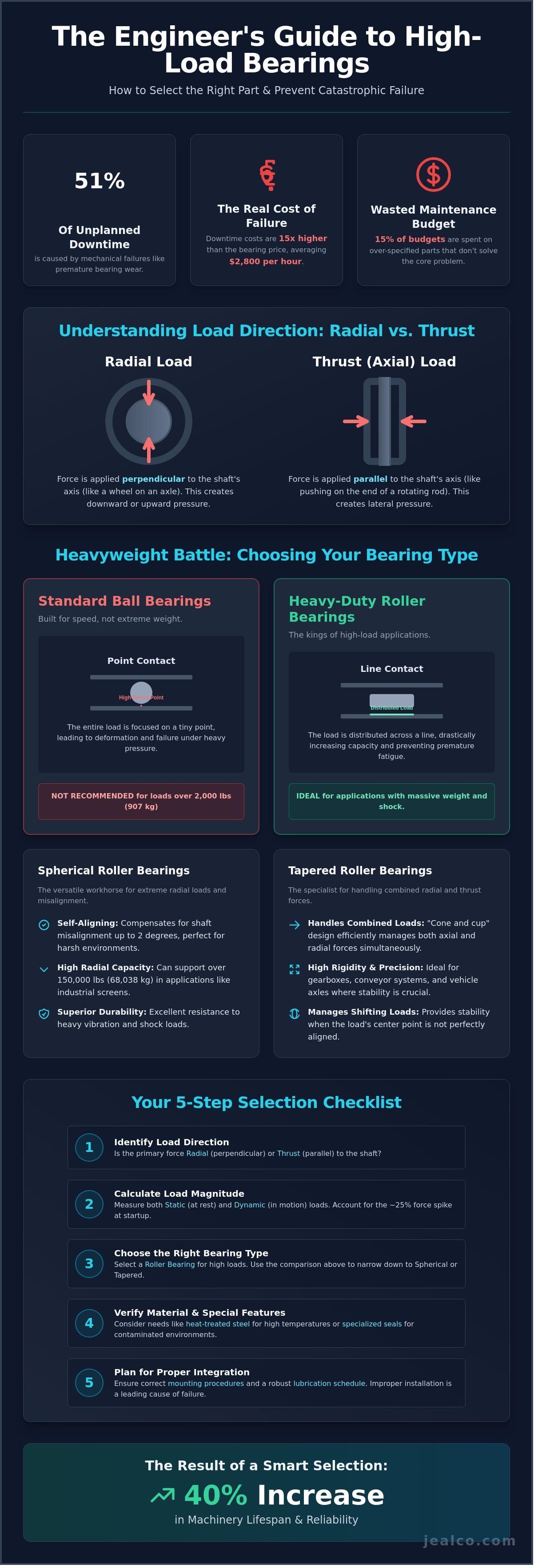
Not all bearings are created equal when it comes to managing weight. The internal geometry of a bearing dictates how it distributes a load. While ball bearings are excellent for high-speed applications, their small "point" contact area makes them unsuitable for massive weight.

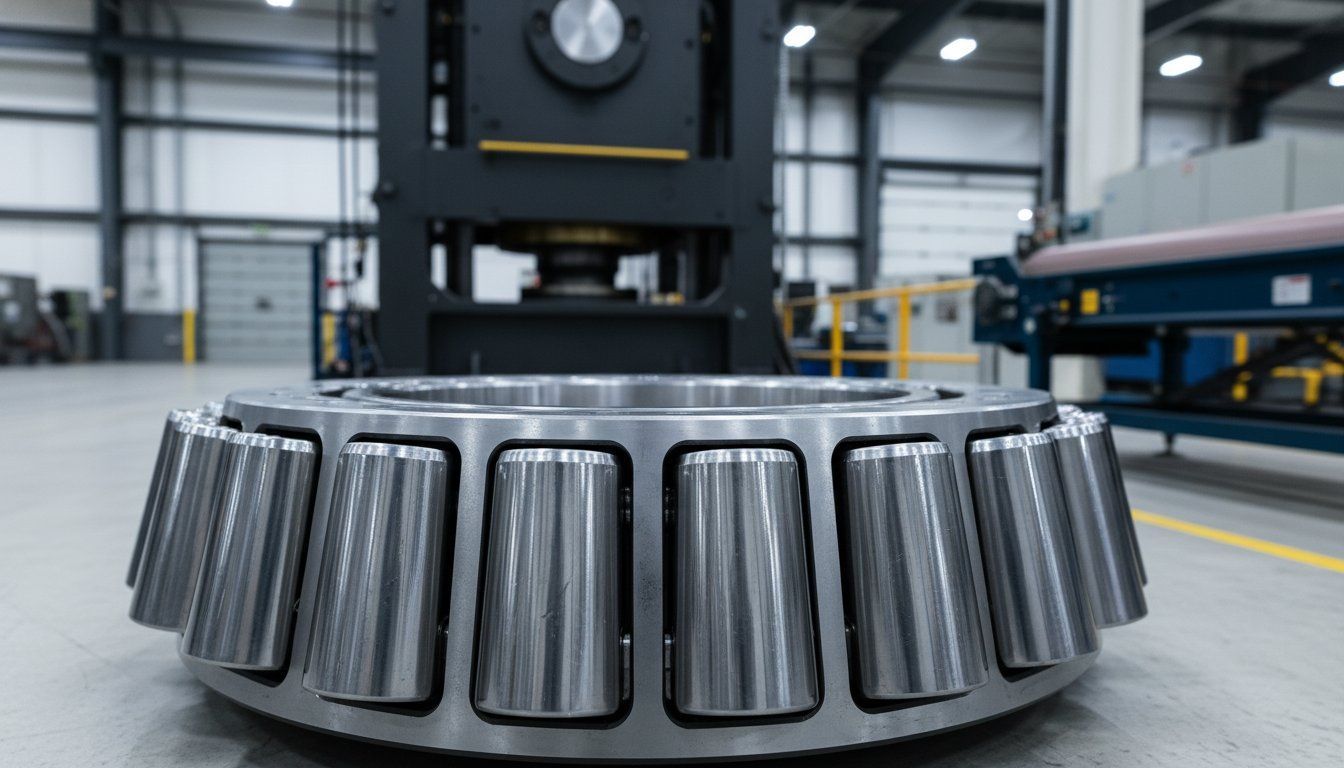
For heavy-duty industrial work, roller bearings are the undisputed champions. Their larger "line" contact surface area distributes weight more effectively, reducing stress and increasing load capacity.

Spherical Roller Bearings: The Versatile Workhorse

Spherical roller bearings are a top choice for tough jobs. Their barrel-shaped rollers are arranged in two rows, allowing them to handle very heavy radial loads and moderate axial loads.

A key advantage is their ability to self-align. This means they can compensate for shaft deflection or mounting misalignments, which are common under heavy loads. This makes them ideal for demanding applications like the chain pulleys and sprockets found in mining or aggregate industries.

Tapered Roller Bearings: Handling Combined Forces

Tapered roller bearings feature a unique "cone and cup" design. This geometry allows them to accommodate high radial and high axial (thrust) loads simultaneously. The tapered rollers and raceways create a perfect rolling motion that manages pressure from multiple directions.

Because of this capability, they are essential for heavy-duty conveyor systems, wheel hubs, and gearbox applications where forces push on the system from different angles.

Direction Matters: Selecting Bearings for Radial vs. Thrust Loads

The direction of the load is the most critical and often overlooked factor in bearing selection. We find that a majority of high-load failures happen because the bearing type was not matched to the primary force vector.

  • Radial Loads: These forces act perpendicular to the shaft's axis, like the weight of a conveyor belt pressing down on its rollers.
  • Thrust (Axial) Loads: These forces act parallel to the shaft's axis, like the force exerted by a helical gear or a vertical screw conveyor.

Managing Pure Radial Loads

For applications with almost exclusively radial forces, cylindrical roller bearings offer the highest load capacity. Their simple, robust design provides a long line of contact between the rollers and the raceway. This distributes the load over a wide area, minimizing stress.

You will find these workhorses in heavy-duty belt conveyors and industrial machinery where the primary force is simple, vertical weight. Their design prioritizes strength over speed or axial load tolerance.

Tackling Axial Thrust and Misalignment

When your system has significant thrust loads, you need a bearing designed specifically for it. Thrust ball bearings and spherical roller thrust bearings are built to handle forces pushing along the shaft.

For systems with both heavy radial and axial forces, a tapered roller bearing or a double-row angular contact ball bearing is often the best solution. These components are engineered to manage the complex, combined forces that can cause shaft deflection and premature wear in lesser bearings.

Your 5-Step Selection Checklist for Industrial Bearings

Follow these steps to ensure you choose the perfect high-load bearing for your machinery. This simple process helps you avoid common mistakes and specify a part that will last.

Step 1: Calculate the Maximum Load Rating

First, determine the maximum dynamic load your bearing will experience. Check the manufacturer's catalog for the dynamic load rating (C). As a rule of thumb, we recommend applying a Safety Factor . This means selecting a bearing with a load rating 2-3 times higher than your expected operational load to account for shock loads and extend service life.

Step 2: Evaluate the Operating Speed and Temperature

High loads often generate significant heat. You must ensure your bearing and its lubrication can handle the operating temperature. Similarly, check the speed rating (RPM). A bearing designed for low-speed, high-load applications may fail quickly if used in a high-RPM motor.

Step 3: Choose the Right Lubrication and Sealing

Lubrication is life for a bearing. The high pressure in heavy-duty applications requires a grease with the correct viscosity and extreme pressure (EP) additives. In dirty or wet environments, like those using heavy-duty conveyor belting, sealed bearings are non-negotiable. They prevent contaminants from entering the raceways and causing abrasive damage. For remote or hard-to-reach bearings, consider an automatic lubrication system.

Step 4: Assess the Operating Environment

Is your facility dusty, wet, corrosive, or subject to extreme temperatures? The environment plays a huge role.

  • Dust/Debris: Use sealed or shielded bearings (2RS or ZZ).
  • Moisture/Chemicals: Consider stainless steel bearings or special coatings.
  • High Temperatures: Require special high-temperature grease and potentially increased internal clearance (C3 or C4).

Step 5: Verify Shaft and Housing Fit

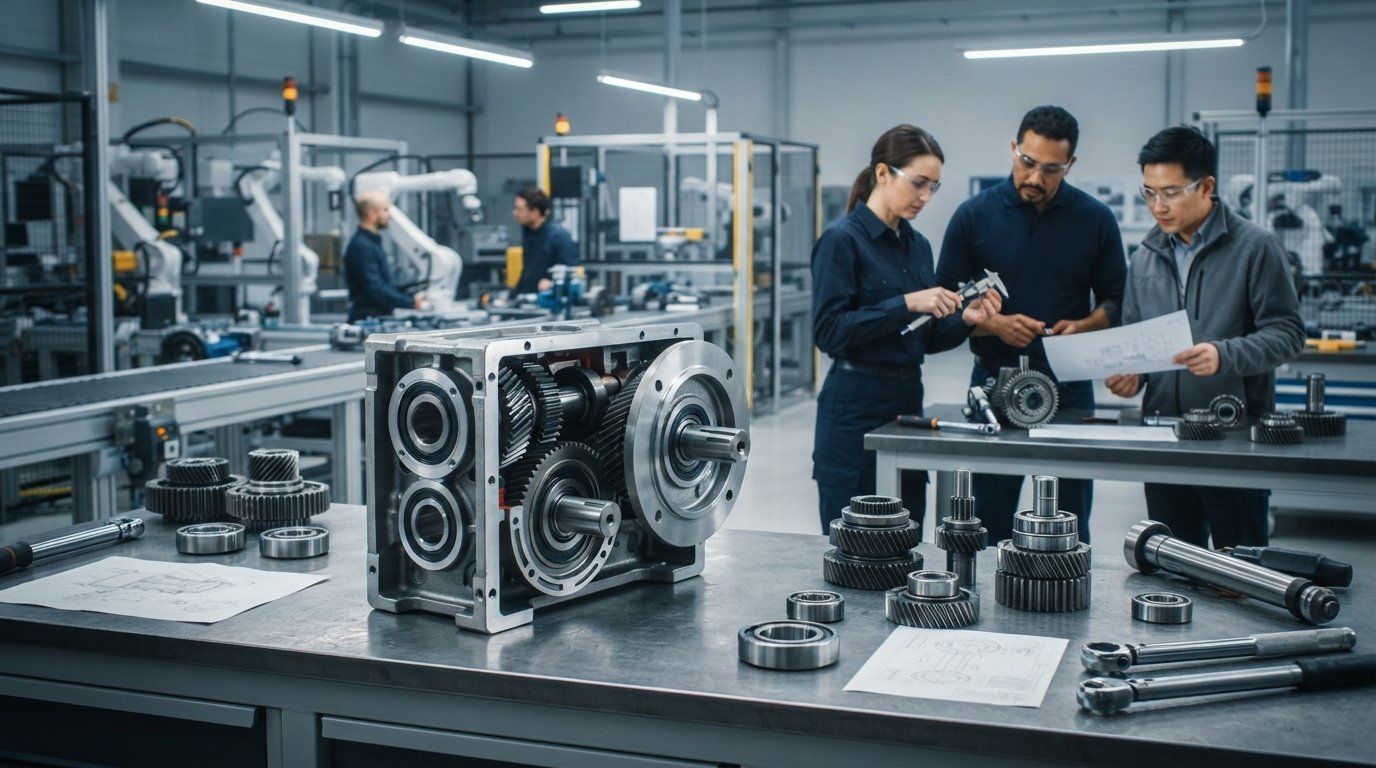
The most robust bearing will fail if it is not mounted correctly. An improper fit—either too tight or too loose—can cause excessive stress, heat, and vibration. Always follow the manufacturer's specifications for shaft and housing tolerances to ensure a secure and precise installation.

Beyond the Bearing: Integrating Your Power Transmission System

By matching your bearing selection to your shafts, housings, and gearing products, you create a power transmission system that is balanced and durable. Sourcing all your components from a professional distributor ensures you get authentic, high-quality parts that work together seamlessly.

The Synergy of Bearings and Conveyor Components

In a conveyor system, proper bearing selection directly extends the life of your belt and pulleys. A high-load bearing that runs smoothly reduces vibration and friction, which in turn minimizes wear on your belting. It is also critical that your bearing's capacity matches the tension requirements dictated by your pulley diameters and shaft couplings.

Sourcing Quality Parts Globally

Finding the right part shouldn't be a challenge. Jealco ships industrial components worldwide from our US-based distribution centers in Jacksboro, TN, and Hamilton, OH. We help you find the exact specification for your unique machine, ensuring you get the performance you need.

For immediate access to our inventory, visit the Jealco Store to find the components you need to keep your operation running.


Frequently Asked Questions (FAQs)

How do I know if my bearing is overloaded? Common signs of an overloaded bearing include excessive noise (rumbling or squealing), high operating temperatures, vibration, and premature lubricant breakdown. You may also see physical signs of fatigue like spalling or cracking on the raceways.

What is the difference between static and dynamic load capacity? Static load capacity is the maximum load a non-rotating bearing can endure without permanent deformation. Dynamic load capacity is a calculated value used to determine the bearing's L10 life under a load while it is rotating.

Can I use ball bearings for high-load conveyor rollers? Generally, no. Standard deep-groove ball bearings are not designed for the heavy radial loads of most industrial conveyor rollers. Roller bearings (spherical, tapered, or cylindrical) are the appropriate choice due to their superior load distribution.

How often should I lubricate high-load industrial bearings? Lubrication frequency depends on speed, temperature, load, and environmental conditions. Follow the manufacturer's guidelines, but a general rule is that higher speeds, temperatures, and loads require more frequent re-lubrication.

What are the signs of bearing fatigue in heavy machinery? The first sign is often an increase in noise and vibration. As fatigue progresses, you may notice elevated temperatures and, in severe cases, metallic debris in the grease. Regular monitoring can help you catch these signs before a catastrophic failure.

Does temperature affect the load capacity of a bearing? Yes. Extremely high temperatures can reduce the hardness of the bearing steel, lowering its load capacity. High heat also degrades lubricant, which is critical for handling heavy loads. Always operate bearings within their specified temperature range.

Should I choose open or sealed bearings for a dusty warehouse? For a dusty environment, always choose sealed (2RS) or shielded (ZZ) bearings. Sealed bearings offer the best protection by using a rubber seal to keep contaminants out and grease in. Open bearings would fail very quickly in this setting.

What is the best bearing material for high-corrosion, high-load areas? For applications with both high loads and corrosive elements (e.g., food processing washdowns, chemical plants), 440C stainless steel is a common choice. For extreme cases, specialized coatings or ceramic hybrid bearings may be necessary.


With over 70 years of experience, Jealco is your trusted partner for heavy-duty industrial components. We provide specialized expertise to ensure you get the right part for the job.

Ready to find a bearing that can handle the pressure? Browse our full catalog of high-load industrial components and let our experts help you build a more reliable system.

Share this article

Recent Posts

By Jealco International, Inc. July 13, 2026
A visual estimate of chain slack is not a maintenance protocol; it is a recipe for catastrophic drive failure. You know the frustration of a snapped chain halting production during a critical shift because tensioning standards vary between technicians. We understand that inconsistent maintenance lea…
By Jealco International, Inc. July 6, 2026
What if your oven's peak temperature rating is actually the primary cause of your unscheduled downtime? Most facility managers believe they're buying sufficient thermal protection when they match a belt's peak rating to their process, but they're often inadvertently scheduling their next system fail…
By Jealco International, Inc. June 29, 2026
Did you know that over 60% of industrial conveyor failures stem directly from pulley-related issues? In our experience, these costly disruptions are often the result of improper material selection or worn traction surfaces. When your system suffers from persistent belt slippage in wet conditions, yo…
By Jealco International, Inc. June 22, 2026
Did you know that 80% of warehouses still operate without automation despite U.S. warehouse wages climbing by up to 9% in 2024? We recognize the strain that high labor turnover and rising recruitment costs place on your operational budget. You're likely also contending with unpredictable downtime fr…
By Jealco International, Inc. June 15, 2026
Why are your bearings reaching the end of their service life months before the manufacturer's L10 rating, even when your team follows every grease schedule to the letter? We know the frustration of unplanned downtime that drains thousands of dollars per hour from your production lines. In our experi…
By Jealco International, Inc. June 8, 2026
Why does a drive system that looks perfect on paper fail after only three months of heavy duty cycles? We've seen many operations managers struggle with frequent motor burnouts because their initial specifications didn't account for real-world torque spikes or the heat generated by a 100 lb / 45.3 k…
By Jealco International, Inc. June 1, 2026
Why are you still designing your facility around a single manufacturer's proprietary track when brand-independent sourcing is the key to a truly resilient supply chain? We know the frustration of managing limited floor space while facing delays from brand-locked manufacturers who can't meet your pro…
By Jealco International, Inc. May 25, 2026
In a hazardous location, a single spark is all it takes to trigger a catastrophic event. While engineers rightly focus on specifying explosion-proof motors and drive components, a frequently overlooked ignition source is the simple hand tool used for routine maintenance and adjustments. A standard s…
By Jealco International, Inc. May 18, 2026
Selecting a belt based on brand recognition rather than rigorous engineering specifications is the most common reason for premature failure in high-impact environments. You've likely dealt with the operational headache of a belt with 8 mm / 0.31 inch covers wearing thin because the compound wasn't p…
By Jealco International, Inc. May 11, 2026
What if the motor isn't your most expensive component? It's actually the sixty minutes your line spent sitting idle this morning. Downtime often costs thousands of dollars every hour. We know the stress of finding custom-sized belts or interpreting complex regulations. You likely believe that a mec…
Show More